

If you have ever stood in your kitchen wondering whether to take your supplements before breakfast or after a workout, you are not alone. Timing questions are one of the most common things people get wrong with supplementation, not because they are difficult, but because the answer differs depending on what you are taking and why.
Beetroot and vitamin B12 are two supplements that often appear in the same daily routine. Both support energy and physical performance, but they work through completely different mechanisms, which means the optimal timing for each is different, too.
The honest answer: for most people, consistency matters more than the exact hour. But there are specific timing windows that the evidence supports, and knowing them means you are getting more from every dose.
Here is what the research actually says.
When to Take Vitamin B12
Vitamin B12 is a water-soluble vitamin which shapes everything about when and how to take it. Unlike fat-soluble vitamins such as D or K, B12 does not require food or dietary fat to be absorbed. That gives you more flexibility, but morning still wins for two clear reasons.
Morning on an empty stomach is the evidence-backed choice
The case for morning B12 is grounded in its direct influence on melatonin. A study published in Neuropsychopharmacology found that both methylcobalamin and cyanocobalamin significantly reduced urinary melatonin metabolite excretion, with the most pronounced suppression occurring between 07:00 and 11:00 hours. Methylcobalamin in particular demonstrated a clear alerting effect, reducing sleep time and improving self-reported concentration and feeling refreshed. A separate study in Neuroscience Letters (PMID: 8981490) confirmed that B12 enhances the circadian melatonin rhythm's response to morning light exposure, reinforcing its role as a morning-aligned nutrient. Taking B12 late in the day works against this mechanism.
There is also an absorption argument. B12 is best absorbed when stomach acid levels are at their peak, which tends to be in the morning before food. Taking it on an empty stomach, with a glass of water, removes the possibility of interference from other nutrients consumed alongside it.
Practical guidance for B12 timing:
-
Take it first thing in the morning, before breakfast
-
A glass of water is all you need; no food required
-
If you have a sensitive stomach, a light snack is fine, though absorption may be marginally better without
-
Avoid taking it alongside high-dose vitamin C, which may interfere with absorption
-
If you take metformin or proton pump inhibitors, speak to your GP about spacing, as these medications can reduce B12 uptake
Does the form of B12 matter?
Yes, and it is worth knowing. Methylcobalamin is the active, bioavailable form of B12 that your body can use directly. Cyanocobalamin, the cheaper and more common form, must first be converted by the body before it becomes usable. For most people, both forms are effective, but methylcobalamin is generally considered the better choice, particularly for those with MTHFR gene variants that affect B12 metabolism.
The form does not change the timing recommendation. Morning, on an empty stomach, applies to both.
When to Take Beetroot Supplements
Beetroot timing is more nuanced than B12, because it depends heavily on what you are using beetroot for. The active compound in beetroot is dietary nitrate, which the body converts into nitric oxide. Nitric oxide improves blood flow, reduces the oxygen cost of exercise, and supports cardiovascular function. That conversion process takes time, and that is where timing becomes critical.
If you exercise: the 2 to 3 hour window
This is the most evidence-backed timing recommendation in sports nutrition. Research published on PubMed found that following a nitrate bolus, plasma nitrite (the active compound) typically peaks within 2 to 3 hours and remains elevated for a further 6 to 9 hours. The recommendation from researchers is to take beetroot approximately 2 to 3 hours before training or competition.
Studies that administered beetroot juice 90 minutes before exercise showed weaker results than those using a 150 to 180 minute window. The difference in performance outcomes was directly attributed to insufficient time to reach peak nitrite levels in the bloodstream.
What this means in practice:
-
Morning gym session at 7am: take beetroot at 4:30 to 5am
-
Lunchtime run at 1pm: take beetroot at 10 to 11am
-
Evening workout at 6pm: take beetroot at 3 to 4pm
Key point: Beetroot does not work like a pre-workout stimulant. It is not an instant effect. The nitric oxide pathway requires time to activate, which is why the timing window matters more than it does for most other supplements.
If you are not exercising, any time is fine
Not everyone takes beetroot for athletic performance. Beetroot is also taken for general cardiovascular support and blood pressure management. For these purposes, the research does not point to a specific time of day being significantly better than another.
In this case, the same rule applies as with most supplements: the best time is the time you will actually remember to take it. Pairing it with a consistent daily habit, such as a morning smoothie or a meal, is far more important than hitting a precise window.
Does food affect beetroot absorption?
Beetroot can be taken with or without food. However, one important note: avoid using antibacterial mouthwash immediately before or after taking beetroot supplements. The conversion of nitrate to nitrite begins in the mouth via oral bacteria. Mouthwash that kills these bacteria can significantly reduce the effectiveness of beetroot supplementation, as noted in dietary nitrate research.
Can You Take Beetroot and B12 Together?
Yes, there are no known interactions between beetroot and vitamin B12. They work through entirely separate pathways, and taking them at the same time will not reduce the effectiveness of either.
That said, if you are exercising, the timing of each supplement pulls in slightly different directions:
|
Supplement |
Optimal timing |
Reason |
|---|---|---|
|
Vitamin B12 |
Morning, on an empty stomach |
Absorption, energy support, sleep protection |
|
Beetroot (for exercise) |
2 to 3 hours pre-workout |
Nitric oxide peak aligns with training window |
|
Beetroot (general use) |
Any consistent time |
Habit and routine matter more than the hour |
If your workout is in the morning, taking both together first thing is a reasonable approach. You will be slightly short of the ideal 2 to 3 hour beetroot window, but the difference is unlikely to be significant for recreational exercisers. Consistency across days matters more than perfect timing on any single day.
If your workout is later in the day, morning B12 and an afternoon beetroot dose is the cleaner approach.
The Rule That Overrides All of This
Timing optimisation is only worth thinking about once you have nailed the basics. The most common reason supplements do not work is not that they were taken at the wrong hour. It is that they were taken inconsistently, in inadequate doses, or in poorly formulated products.
Before worrying about whether your beetroot landed 90 minutes or 150 minutes before your run, make sure:
-
You are taking a clinically relevant dose (research on beetroot typically uses 6 to 8 mmol of nitrate per serving)
-
Your B12 supplement uses a bioavailable form such as methylcobalamin
-
You are taking both supplements every day, not just on training days
The bottom line: timing is the final 10%. Formulation and consistency are the other 90%. Get those right first, then refine your timing around your routine.
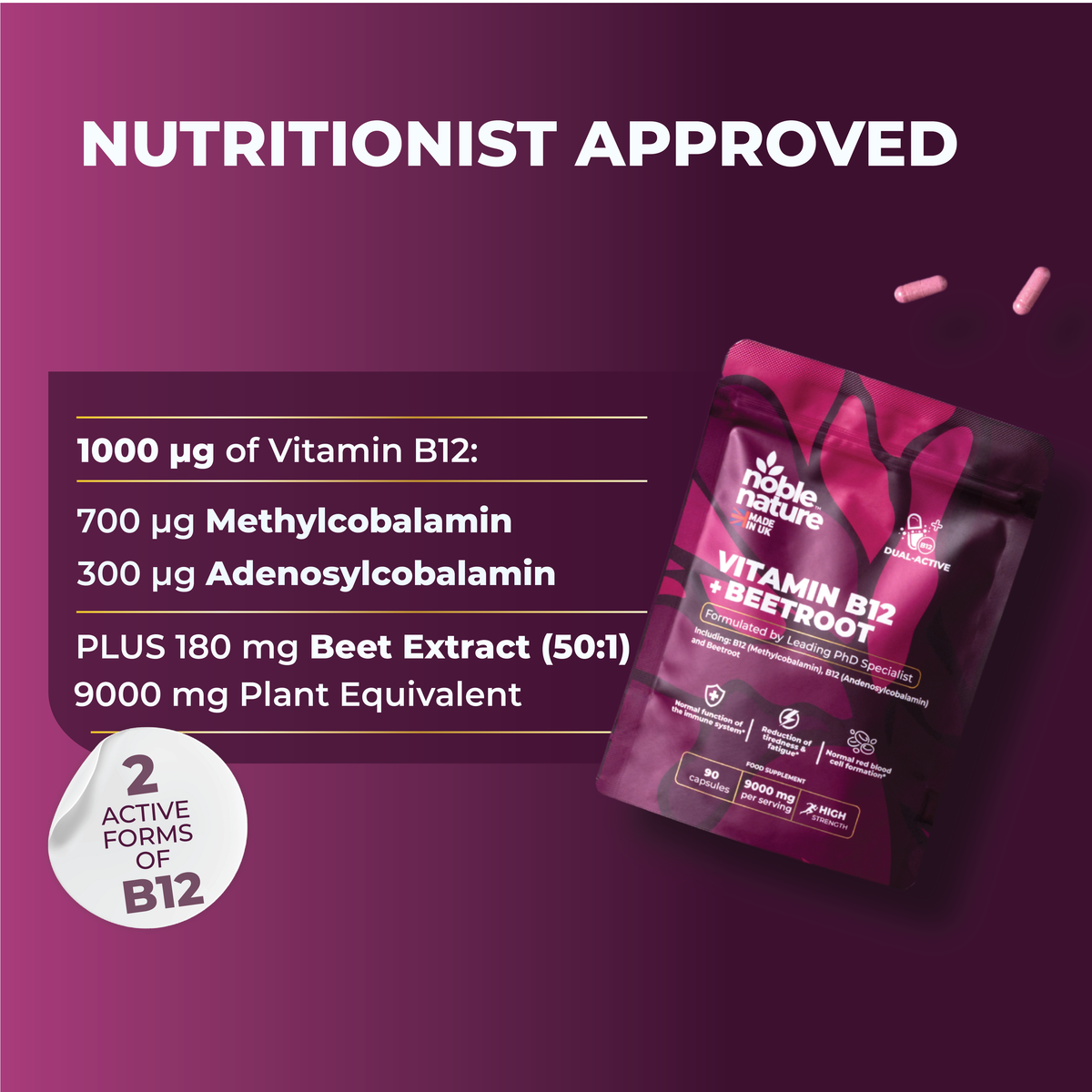
At NobleNature, our beetroot and B12 supplements are formulated with these principles in mind: the right forms, the right doses, and clear guidance so you know exactly how to use them. Explore here.
Share:
GLP-1 and B12: Is There Really a Risk, and Who Should Pay Attention?
Who Should Take Vitamin D3 and K2 Supplements? A UK Evidence Guide