

Most people dealing with mental fatigue and stress try to fix one problem at a time. They reach for a coffee to sharpen focus, or a calming supplement to take the edge off anxiety. What they rarely consider is that focus and stress are two sides of the same coin. A brain under chronic stress cannot concentrate effectively. A brain that cannot concentrate becomes more stressed. The cycle is self-reinforcing.
Lion's mane mushroom (Hericium erinaceus) and ashwagandha (Withania somnifera) address this problem from opposite directions, and that is precisely what makes combining them so compelling. Lion's mane works at the level of neuronal structure, supporting the brain's capacity to process and retain information. Ashwagandha works at the level of the stress response, modulating the hormonal cascade that degrades cognitive performance under pressure. Together, they target the underlying biology of both problems simultaneously.
This article breaks down the science behind each ingredient, explains how they work together, and examines what the clinical evidence actually says.
Key takeaways:
- Lion's mane stimulates nerve growth factor (NGF) and brain-derived neurotrophic factor (BDNF), two proteins essential for neuronal health and cognitive speed
- Ashwagandha modulates the HPA axis to reduce cortisol, the primary stress hormone that impairs focus when chronically elevated
- A 2023 double-blind pilot study at Northumbria University found that lion's mane improved processing speed and was associated with reduced subjective stress after 28 days
- Clinical trials on ashwagandha extract show cortisol reductions of 27-32% and significant improvements on validated stress scales
- The combination addresses both the neurological and hormonal dimensions of focus and stress, which neither ingredient fully covers alone
What Lion's Mane Actually Does in the Brain
Lion's mane is not a stimulant. It does not deliver a short-term spike in alertness the way caffeine does. Its mechanism is slower and more structural, which is both its limitation and its long-term advantage.
The mushroom contains two families of bioactive terpenoids: hericenones (found in the fruiting body) and erinacines (found in the mycelium). Both have been shown to stimulate the synthesis of nerve growth factor (NGF), a protein that plays a fundamental role in the growth, maintenance, and survival of neurons. Critically, both hericenones and erinacines are able to cross the blood-brain barrier, a property that many natural compounds lack and that is essential for any neurological effect to occur.
NGF and What It Means for Focus
NGF is not a nootropic buzzword. It is a well-characterised signalling protein that regulates neuronal health across the central and peripheral nervous systems. When NGF levels are adequate, neurons maintain their structural integrity, synaptic connections remain strong, and cognitive processing runs efficiently. When NGF declines, which happens with age and under chronic stress, those connections degrade.
A 2025 review published in PMC confirmed that erinacines and hericenones stimulate NGF synthesis and promote neuronal growth and repair. The review also noted that these compounds inhibit NF-kB activation, a key inflammatory signalling pathway, reducing the neuroinflammation that is increasingly linked to cognitive decline and poor concentration.
BDNF: The Second Mechanism
Beyond NGF, lion's mane also appears to influence brain-derived neurotrophic factor (BDNF). BDNF regulates synaptic plasticity, the brain's ability to strengthen connections between neurons in response to learning and experience. According to the Northumbria University pilot study (2023), an increase in circulating pro-BDNF was observed in humans following lion's mane supplementation, alongside improvements in memory and mood. The researchers noted that BDNF is also considered a key factor in vulnerability to stress, which provides a direct mechanistic bridge between lion's mane, cognitive performance, and stress regulation.
The practical implication: lion's mane supports the brain's underlying infrastructure. It is not a quick fix. It is a structural intervention that, over weeks of consistent use, may contribute to faster information processing and improved resilience to cognitive load.
The Clinical Evidence on Lion's Mane and Cognitive Performance
The mechanistic case for lion's mane is strong. The human clinical evidence is promising, though it is worth being precise about what has been demonstrated.
The most rigorous human trial to date is the 2023 double-blind, parallel-groups pilot study from Northumbria University, published in the Journal of Dietary Supplements. The trial enrolled healthy young adults and assessed both acute (single dose) and chronic (28-day) effects of lion's mane supplementation.
The findings were notable on two counts:
- Processing speed: A single dose of lion's mane led to significantly faster performance on the Stroop task (p = 0.005) at 60 minutes post-dose, a measure of cognitive processing speed and executive function.
- Stress reduction: After 28 days of supplementation, participants in the lion's mane group reported significantly lower subjective stress scores compared to placebo (mean = 33.02 vs. 42.53, p = 0.033).
The researchers were appropriately cautious about the small sample size, but the direction of the findings is consistent with the mechanistic evidence. It is also worth noting that the stress reduction effect was observed on the Stress Visual Analogue Scale but not the Perceived Stress Scale, suggesting the effect may be more acute or experiential than globally measured. Further large-scale trials are needed to confirm these results.
What this means in practice: Lion's mane may support both immediate cognitive performance and, with consistent use, a reduction in how stressed the brain feels under load. The acute processing speed effect is particularly relevant for people who need to perform under pressure.
How Ashwagandha Addresses the Stress Side of the Equation
Ashwagandha operates on a completely different biological system. Where lion's mane targets neuronal structure and growth factors, ashwagandha targets the hormonal stress response, specifically the hypothalamic-pituitary-adrenal (HPA) axis.
When the body encounters stress, the HPA axis triggers the release of cortisol. In short bursts, cortisol is useful. It sharpens alertness and mobilises energy. But when cortisol remains chronically elevated, the effects reverse: memory consolidation is impaired, the prefrontal cortex (responsible for decision-making and focus) becomes less active, and anxiety increases. Chronic stress, in neurological terms, actively degrades the cognitive functions people are trying to protect.
The Withanolide Mechanism
Ashwagandha's active compounds are steroidal lactones called withanolides. These compounds are believed to modulate HPA axis activity, helping to normalise elevated cortisol levels and return the body toward homeostasis. Ashwagandha also demonstrates a GABA-mimetic effect, reducing the over-excitation of neurons that drives anxiety and mental restlessness.
According to the National Institutes of Health Office of Dietary Supplements, multiple clinical trials have found that ashwagandha significantly reduces both subjective stress scores and serum cortisol levels compared to placebo. Benefits appear to be greater at doses of 500 to 600 mg per day.
What the Clinical Trials Show
The evidence for ashwagandha on stress and cortisol is among the most robust in the adaptogen category:
| Study | Dose | Duration | Key Finding |
|---|---|---|---|
| Indian Journal of Psychological Medicine (RCT, n=64) | 300 mg KSM-66 | 60 days | 27.9% reduction in serum cortisol; 44% reduction on Perceived Stress Scale |
| Cureus (RCT, n=60, ages 18-55) | 600 mg KSM-66 | 8 weeks | 32% cortisol reduction; 38% reduction on Perceived Stress Scale |
| NIH-reviewed multi-centre trial (n=130) | 300 mg standardised extract | 90 days | Reduced cortisol; improvements in memory, focus, and psychological wellbeing |
The consistency across multiple independent trials is significant. Ashwagandha's cortisol-lowering effect is not a single finding. It has been replicated across different populations, doses, and study designs.
The key insight: Reducing cortisol does not just make people feel calmer. It directly removes one of the primary biological obstacles to sustained cognitive focus. Lower cortisol means the prefrontal cortex can function more effectively, attention is less fragmented, and working memory improves.
Why the Combination Works Better Than Either Ingredient Alone
This is the question that matters most, and the answer comes down to the difference between treating a symptom and addressing a system.
Lion's mane builds the brain's capacity for focus by supporting the neuronal infrastructure that makes sharp thinking possible. But if cortisol remains chronically elevated, that infrastructure is constantly being undermined. Stress degrades the same neuronal connections that lion's mane is working to strengthen. The two processes work against each other.
Ashwagandha removes that obstacle. By modulating cortisol and calming HPA axis overactivity, it creates the hormonal environment in which lion's mane's neurological benefits can take hold. Less cortisol means less neuroinflammation. Less neuroinflammation means better conditions for NGF and BDNF to do their work.
The relationship is not simply additive. It is complementary in a specific and mechanistically coherent way.
How the Two Pathways Interact
| Lion's Mane | Ashwagandha | |
|---|---|---|
| Primary target | Neuronal structure and growth factors | HPA axis and cortisol regulation |
| Key compounds | Hericenones, erinacines | Withanolides |
| Main mechanism | Stimulates NGF and BDNF synthesis | Reduces cortisol; GABA-mimetic effect |
| Effect on focus | Supports processing speed and synaptic plasticity | Removes hormonal interference with prefrontal function |
| Effect on stress | May reduce subjective stress via BDNF pathways | Directly lowers serum cortisol levels |
| Timeline | Structural; effects build over weeks | Can reduce cortisol markers within 30-60 days |
The result of combining them is a formulation that addresses both the neurological capacity for focus and the hormonal conditions that allow that capacity to be expressed. One builds the engine. The other clears the road.
There is also a practical consideration around timing. Lion's mane is generally better suited to morning use, given its stimulatory effect on alertness. Ashwagandha can be taken at any time, though some evidence suggests evening use may further support sleep quality, which in turn reinforces cognitive performance the following day. A combined formula taken in the morning covers both mechanisms without the need to manage two separate supplements.
What to Look for in a Lion's Mane and Ashwagandha Supplement
The supplement market is crowded, and not all lion's mane or ashwagandha products are equivalent. Formulation quality matters significantly, particularly for these two ingredients.
Lion's Mane: Fruiting Body vs. Mycelium
This distinction is important and frequently misrepresented. Hericenones are found in the fruiting body. Erinacines are found in the mycelium. Both contribute to NGF stimulation, but many cheaper products use mycelium grown on grain, which dilutes the active compound concentration with starch. A quality lion's mane supplement should specify the source and ideally standardise for beta-glucan content, the polysaccharide fraction associated with bioactivity.
Ashwagandha: Standardised Extracts
The clinical trials that produced the strongest results used ashwagandha extracts standardised to a defined withanolide content. The most studied extract is KSM-66, a full-spectrum root extract standardised to a minimum of 5% withanolides. Products that simply list "ashwagandha root powder" without standardisation offer no guarantee of active compound content.
Additional quality markers to consider:
- Third-party lab testing: Confirms the stated active compound levels are present in the finished product
- UK manufacturing: Ensures the product is made to UK Good Manufacturing Practice (GMP) standards
- Transparent labelling: No proprietary blends that obscure individual ingredient doses
- No unnecessary fillers: The fewer inactive ingredients, the better
The dose also matters. Based on the clinical evidence, ashwagandha appears most effective at 500 to 600 mg per day of a standardised extract. Lion's mane research has used varying doses, but 500 mg and above of a quality extract is the range most trials have worked with.
The Bottom Line
Lion's mane and ashwagandha are not interchangeable. They are not even doing the same job. One supports the brain's capacity to focus at a structural level. The other removes the hormonal conditions that undermine that capacity. Used together, they address the two most significant biological barriers to sustained cognitive performance: inadequate neuronal support and chronic stress-driven cortisol elevation.
The clinical evidence for each ingredient individually is credible, backed by multiple randomised controlled trials and mechanistic research published in peer-reviewed journals. The logic of combining them is sound and mechanistically coherent, even if direct combination trials in humans are still limited.
For anyone experiencing the familiar pattern of mental fatigue, difficulty concentrating under pressure, and a background hum of stress that never fully switches off, this combination targets the underlying biology rather than masking the symptoms.
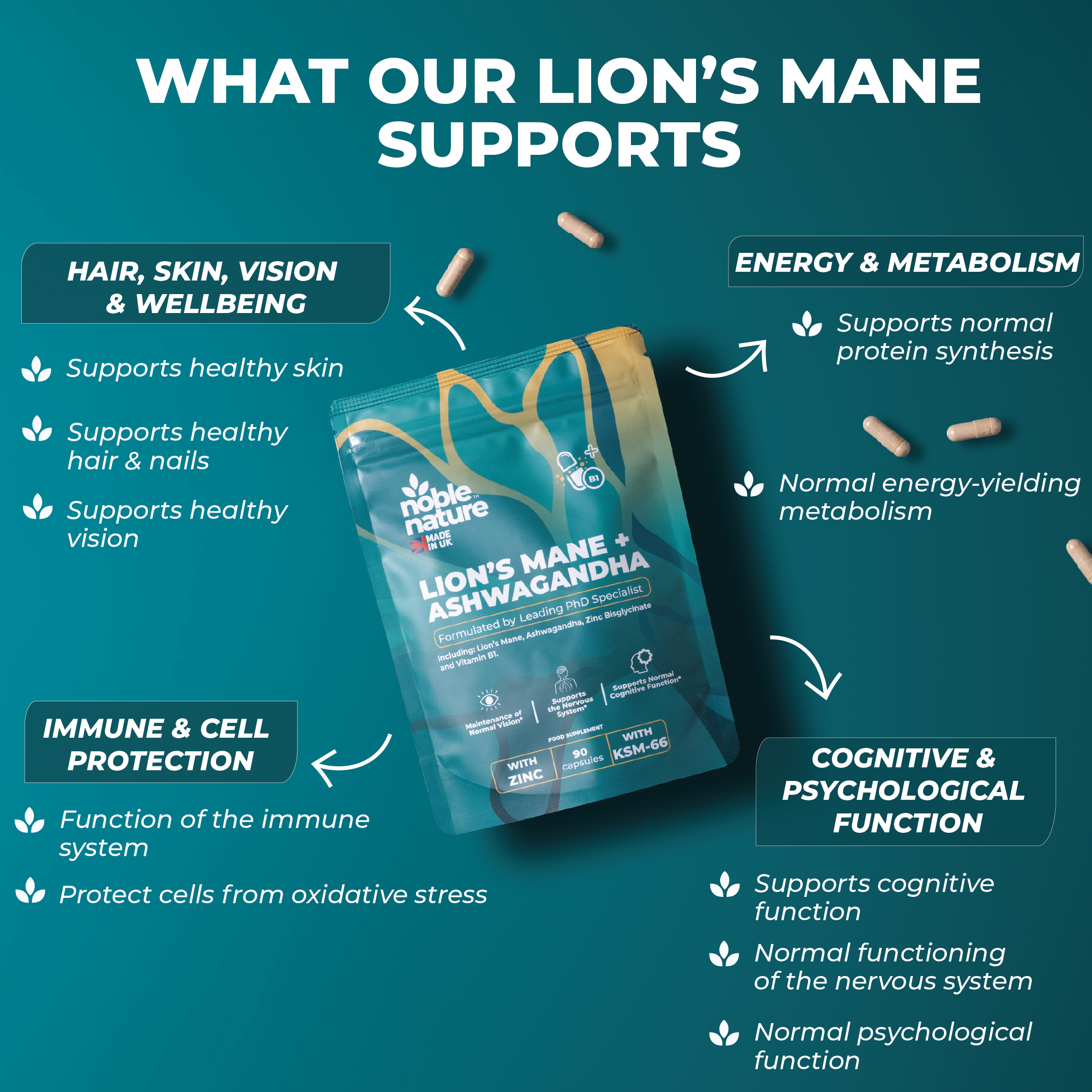
NobleNature's Lion's Mane with Ashwagandha is formulated to UK manufacturing standards, developed in collaboration with a PhD scientist and registered nutritionist, and supported by third-party lab testing. If you are looking for a science-led approach to focus and stress support, explore the Lion's Mane with Ashwagandha 4-in-1 formulation here.
Share:
Ashwagandha and Cortisol: What the Clinical Evidence Actually Shows
Magnesium Glycinate for Sleep and Muscle Recovery: What the Evidence Actually Shows