
If you take ashwagandha or you're thinking about it, something happened in April 2026 that is worth knowing about. India's two most powerful food and medicine regulators issued back-to-back directives banning the use of ashwagandha leaves in any supplement, nutraceutical, or food product. Not leaves from a particular supplier. Not leaves above a certain concentration. All leaves, in any form.
This wasn't a surprise to anyone paying attention. What it exposed, however, was how widespread the problem had already become and why the extract you choose matters far more than most brands will tell you.
The short version: a large portion of the ashwagandha market has been quietly cutting corners for years, using cheap leaf material to bulk out products labelled simply as "ashwagandha." The April 2026 ban is the clearest signal yet that regulators have had enough. If your supplement doesn't specify root-only and doesn't use a clinically verified extract, you genuinely don't know what you're taking.
What the April 2026 Ban Actually Says
On 15 April 2026, India's Ministry of AYUSH issued a formal directive (reference T-13020/4/2022-DCC-Part(2)) mandating that only ashwagandha roots may be used in Ayurvedic formulations. The following day, the Food Safety and Standards Authority of India (FSSAI) issued its own advisory (F.No. RCD-15001/11/2021-Regulatory-FSSAI) extending the same prohibition to all food products and nutraceuticals, directing state enforcement authorities to take immediate action against non-compliant manufacturers.
Both directives are explicit: ashwagandha leaves cannot be used "in crude or extract or any other form."
This enforcement action followed a 2021 advisory that was, by most accounts, largely ignored. The scale of the problem became undeniable when government data revealed that in 2024-2025, 4,698 tonnes of ashwagandha leaves were sold in India compared to just 4,170 tonnes of roots. More leaves were moving through the supply chain than roots. For a plant whose leaves have never been part of traditional internal use in over 4,000 years of Ayurvedic practice, that figure is striking.
Why Leaves Were Being Used at All
The answer is straightforward: cost. Ashwagandha leaves sell for up to 100 times less than roots. For manufacturers operating on thin margins or prioritising profit over quality, substituting leaf material while still labelling the product as "ashwagandha" was an easy way to cut costs without consumers noticing.
Roy Upton, founder of the American Herbal Pharmacopoeia, put it plainly: "There is no historical precedent for use of the leaves." Yet large volumes of leaf material had been quietly entering the global supplement supply chain, often without disclosure on the label.
The Science Behind the Safety Concern
The regulatory concern isn't arbitrary. It comes down to a specific compound: Withaferin A, a cytotoxic withanolide found in far higher concentrations in ashwagandha leaves than in the root.
The chemical difference is significant:
|
Compound |
Root Content |
Leaf Content |
|---|---|---|
|
Withaferin A |
0.92 mg/g |
22.31 mg/g |
|
Withanone |
3 mg/g |
19 mg/g |
Withaferin A in the leaf is present at roughly 24 times the concentration found in the root. According to published research, both Withaferin A and Withanone have been associated with liver toxicity in several reports. Laboratory studies suggest that Withanone may also cause DNA damage, particularly in individuals with low glutathione levels.
This is not a theoretical risk. A study of young cancer patients taking a root extract with an unusually high 4.5% Withaferin A content at doses of 1,600-4,800mg per day found elevated liver enzymes in five of eleven participants. Leaf-containing products carry significantly higher baseline levels of this compound.
What the Clinical Evidence Actually Shows
The research base for ashwagandha is substantial, but it is almost entirely built on root-based formulations. Of the 427 clinical trials registered for ashwagandha, 426 use the root or root-based formulations. Just one incorporates the leaf.
The EFSA (European Food Safety Authority) currently has 11 pending health claims for root-based ashwagandha, but only two of those can be applied to leaf-based extracts. European countries, including Poland and Hungary, already legally restrict ashwagandha supplements to root-only use.
The practical implication: if a product contains leaf material, it is not supported by the same body of evidence that gives ashwagandha its reputation for supporting stress resilience, sleep quality, and physical performance.
Why KSM-66 Is the Benchmark Extract
Not all root extracts are equal. The extract standard matters as much as the plant part, and KSM-66 is the most extensively studied branded ashwagandha extract on the market.
Produced by Ixoreal Biomed using a proprietary green-chemistry extraction process (no alcohol or chemical solvents), KSM-66 is:
-
Root-only - no leaf material, ever
-
Standardised to a minimum of 5% withanolides - ensuring consistent, measurable potency
-
Backed by 22 gold-standard, double-blind, placebo-controlled human clinical trials - covering stress, anxiety, sleep quality, cognitive function, physical performance, testosterone, and fertility
-
Certified organic, non-GMO, vegetarian, Kosher, and Halal
-
In market since 2012 - with a longer real-world safety record than any comparable extract
The clinical evidence supporting KSM-66 makes it the default choice for formulators who take the science seriously. A study found that 600mg of KSM-66 daily for 60 days significantly reduced perceived stress and cortisol levels versus placebo. Separate trials have demonstrated improvements in sleep quality, muscle recovery, and male fertility markers.
How It Compares to Other Extracts
|
Extract |
Plant Part |
Clinical Trials |
Withanolide Standardisation |
|---|---|---|---|
|
KSM-66 |
Root only |
22 gold-standard |
5% withanolides |
|
Sensoril |
Root + leaf |
12 trials |
10% withanolide glycosides |
|
Shoden |
Root + leaf |
3 trials |
35% withanolide glycosides |
Sensoril and Shoden both incorporate leaf material. Their higher withanolide percentages are partly a function of that leaf content, not purely superior root extraction. Following the April 2026 regulatory action, any extract containing leaf material now operates outside the framework endorsed by the world's primary ashwagandha regulators.
KSM-66 is by far the most consumer-searched ashwagandha brand globally - and the only root-only extract with a clinical trial library that covers the full range of outcomes people actually take ashwagandha for.
What to Look for on a Label
The April 2026 directives also introduced mandatory labelling requirements: manufacturers must now clearly declare the plant part used. That change gives consumers a practical tool.
When evaluating any ashwagandha product, check for the following:
-
"Root extract" or "root only" - not just "ashwagandha extract," which can include leaf material
-
A named, standardised extract - KSM-66 is the most widely recognised; generic extracts offer no traceability
-
A stated withanolide percentage 5% is the standard for KSM-66; anything unstated is a red flag
-
Third-party testing or certificates of analysis - confirms the label matches what's inside
If a product simply says "ashwagandha" with no further detail, that ambiguity is the problem. Before April 2026, it was plausible that "ashwagandha" meant something well-formulated. Now, in the context of a global market where leaf adulteration was rampant, vague labelling should prompt questions.
The Bigger Picture for UK Consumers
The AYUSH and FSSAI directives are Indian regulations, not UK law. But the global supplement supply chain is deeply interconnected. The vast majority of ashwagandha raw material originates in India, and the adulteration problem is not geographically contained. UK consumers buying products without verified root-only extracts are exposed to the same risks that prompted the ban.
The honest takeaway: the regulation validates what good formulators have always known. Root-only, clinically verified ashwagandha has a 4,000-year track record and a growing body of human clinical evidence. Leaf-containing products have neither.
The NobleNature Approach
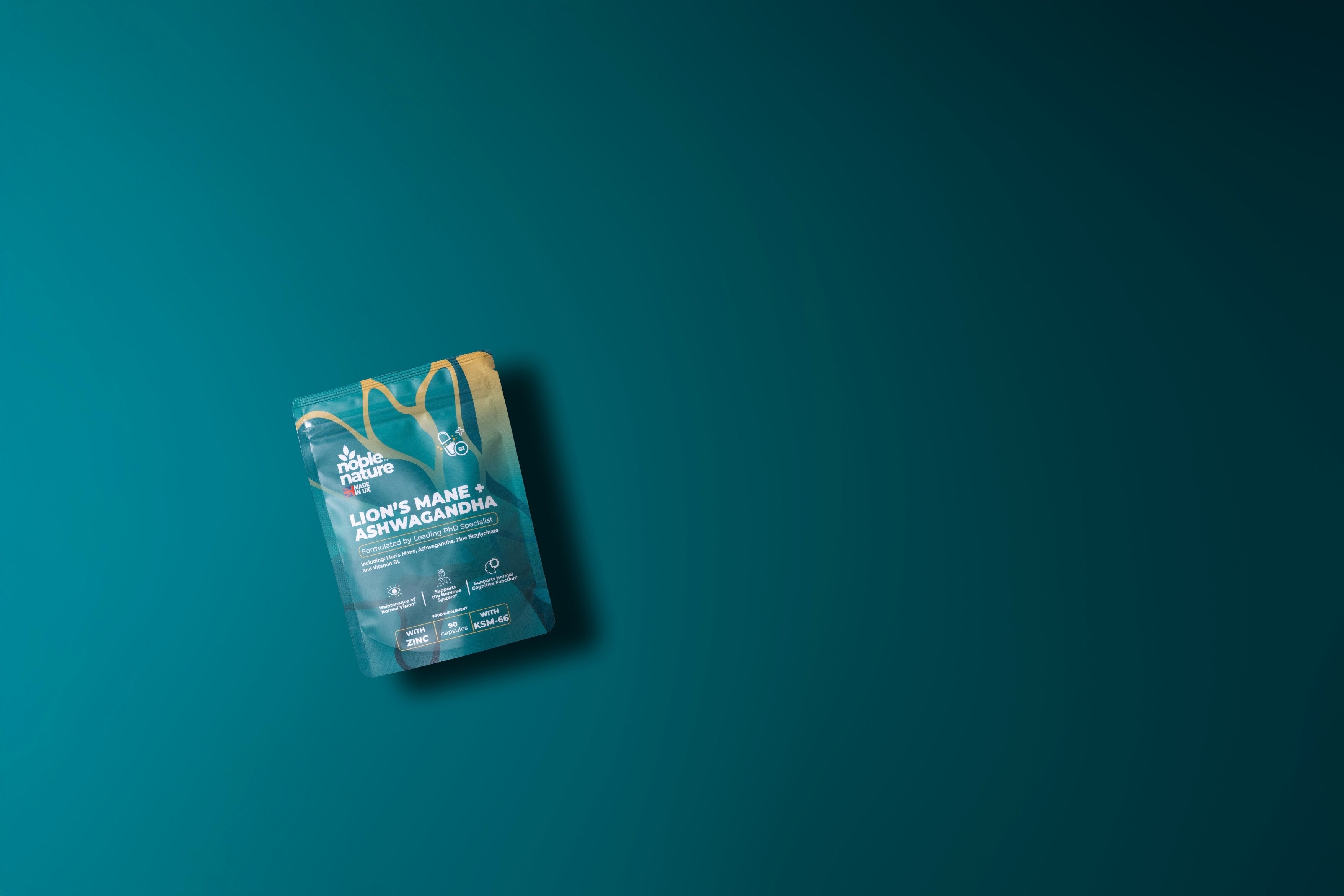
NobleNature's Lion's Mane and Ashwagandha 4-in-1 uses KSM-66 Ashwagandha root-only, standardised to 5% withanolides, and backed by the full clinical evidence base described above. The formulation was developed alongside a PhD pharmacologist and certified nutritionist, manufactured in a BRCGS-certified UK facility, and supported by third-party certificates of analysis.
This isn't a response to the April 2026 ban. It's the standard the formula was built to from the start.
If you are currently taking an ashwagandha supplement that doesn't specify the plant part or the extract type, it is worth checking. The regulation exists because the problem was real and widespread. Choosing a verified, root-only extract is the simplest way to ensure you are getting what the research actually supports.
Share:
Should You Take Beetroot Supplementation? Who It Actually Helps (and Who It Doesn't)
Why Is Everyone Talking About Vitamin D3? The UK Deficiency Problem Explained