

Why Eye Health Belongs in Every Longevity Plan
Most people think about eye health when their vision starts to blur. That's the wrong starting point.
In longevity science, the eyes are increasingly recognised as one of the most informative windows into how your body is ageing. Not just your visual system your cardiovascular health, your neurological function, your biological age relative to your chronological years. A 2023 study published in the British Journal of Ophthalmology (PMID: 35042683) found that a deep-learning model could predict chronological age from retinal images with a mean absolute error of 3.55 years, and that each one-year increase in the retinal age gap was associated with a 2% increase in all-cause mortality risk.
The real insight: protecting your eyes isn't just about preserving vision. It's about preserving the systems that vision reflects.
This matters for anyone serious about longevity. The eyes age in ways that are measurable, trackable, and, critically, modifiable. Understanding what drives ocular ageing, and what you can do about it, is no longer niche ophthalmology. It sits squarely in the mainstream longevity conversation.
The Eye as a Longevity Biomarker
The longevity field has long relied on biomarkers that require invasive sampling: blood draws, tissue biopsies, epigenetic clock assays. The eye offers something different. It is the only place in the human body where blood vessels and neural tissue can be observed directly, without any incision.
That structural transparency makes the retina uniquely valuable. Researchers have identified several key ocular biomarkers that track biological ageing:
-
Retinal age gap: The difference between your chronological age and the age an AI model estimates from your retinal scan. A larger gap (retina appearing older than you are) has been associated with increased mortality risk in UK Biobank data. A 2023 British Journal of Ophthalmology study found each one-year increase in the retinal age gap carried a 2% higher risk of all-cause mortality, while a 2025 PMC study using 45,436 UK Biobank participants found a 10-year increase in retinal age gap was associated with a 35% increase in mortality risk.
-
Retinal vascular density: Reduced density in retinal blood vessels has been linked to both all-cause mortality and early death, independent of demographic and lifestyle variables, according to research using the UK Biobank.
-
LensAge index: A deep-learning model that estimates biological age from the lens. A positive LensAge index (lens appearing older than chronological age) carries a 26% higher odds ratio for systemic age-related diseases including diabetes, hypertension, cardiovascular disease, and cancer.
-
OCT age gap: Derived from optical coherence tomography scans of retinal structure. A 5-year increase in OCT age gap is associated with an 8% increase in mortality risk.
What This Means in Practice
These aren't abstract research metrics. They indicate that ocular ageing and systemic ageing are running on the same biological clock. When the retina ages faster than expected, it is typically because the same processes driving oxidative stress, chronic inflammation, and microvascular deterioration are also accelerating ageing elsewhere in the body.
The eye doesn't cause these problems. It reflects them. Which is exactly why it's such a useful target for intervention.
How the Eyes Age and Why It Accelerates
Ocular ageing is not a single event. It is a cascade of structural and functional changes that unfold across decades, often silently, until the damage is advanced enough to affect vision.
The key mechanisms driving this process are the same ones that drive systemic ageing:
Oxidative Stress
The retina has one of the highest metabolic rates of any tissue in the body. It is constantly exposed to light, requiring continuous photochemical activity that generates reactive oxygen species (ROS). Over time, accumulated oxidative damage degrades the photoreceptors, the retinal pigment epithelium, and the macular region responsible for sharp central vision.
This is why antioxidant status matters so directly to eye health. The retina is essentially running a high-load oxidative environment every waking hour.
Chronic Inflammation
Low-grade systemic inflammation, sometimes called "inflammageing," is a central driver of biological ageing. In the eye, it contributes to the breakdown of the blood-retinal barrier, the deterioration of retinal capillaries, and the development of conditions like age-related macular degeneration (AMD) and diabetic retinopathy.
Microvascular Deterioration
The retinal vasculature is among the smallest and most delicate in the body. It is highly sensitive to the same risk factors that damage cardiovascular health: poor glucose regulation, hypertension, smoking, and chronic inflammation. Retinal vessel changes often appear before systemic cardiovascular damage becomes clinically detectable which is precisely why researchers are using retinal imaging as an early warning system.
The compounding effect: these three mechanisms do not operate independently. Oxidative stress drives chronic inflammation; inflammation accelerates microvascular damage; microvascular damage reduces the oxygen and nutrient supply to retinal tissue, creating more oxidative stress. The cycle compounds with age unless actively interrupted.
The Nutrients That Matter Most
The evidence base for ocular nutrition is more robust than most areas of supplement science. The Age-Related Eye Disease Studies (AREDS and AREDS2), conducted by the US National Eye Institute, remain among the most-cited clinical trials in nutritional research and have directly shaped our understanding of which nutrients protect the ageing eye. The original AREDS trial established the foundation; AREDS2 (PMID: 23644932) enrolled 4,203 participants and tested the addition of lutein, zeaxanthin, and omega-3 fatty acids to the formulation.
Lutein and Zeaxanthin
These two carotenoids are the primary pigments of the macula. They act as both blue light filters and antioxidants, absorbing incoming short-wavelength light and scavenging free radicals before they can damage photoreceptor cells.
Critically, they are not produced by the body. They must come from diet or supplementation. The AREDS2 10-year follow-up (PMID: 35653117), published in JAMA Ophthalmology in 2022, found that lutein and zeaxanthin supplementation was associated with a hazard ratio of 0.91 for progression to late AMD compared with no lutein/zeaxanthin a persistent benefit that held across the full decade of follow-up. Average dietary intake among UK adults over 50 sits well below the 6 mg/day associated with reduced AMD risk most consume under 2 mg daily.
Vitamins C and E
Both are established antioxidants with direct relevance to ocular tissue. Vitamin C is highly concentrated in the aqueous humour of the eye and is considered a primary defence against age-related cataract formation. Vitamin E protects the critical fatty acids in retinal cell membranes from oxidative degradation. The original AREDS trial found that combined supplementation with vitamins C and E, zinc, and beta-carotene reduced the risk of developing advanced AMD by approximately 25%.
Zinc
Zinc is essential for retinal metabolism and for transporting vitamin A from the liver to the retina, where it is used to produce melanin. Zinc deficiency is associated with impaired night vision and accelerated lens opacification. It also plays a structural role in several retinal enzymes.
The Nutrient Summary
|
Nutrient |
Primary Role |
Key Evidence |
|---|---|---|
|
Lutein & Zeaxanthin |
Macular pigment, blue light filtration |
AREDS2: reduced AMD progression |
|
DHA / EPA (Omega-3) |
Retinal structure, anti-inflammatory |
Neuroprotective; supports macular integrity |
|
Vitamin C |
Antioxidant in aqueous humour |
Linked to reduced cataract risk |
|
Vitamin E |
Protects retinal fatty acids from oxidation |
AREDS1: 25% risk reduction for advanced AMD (combined) |
|
Zinc |
Retinal enzyme function, vitamin A transport |
Deficiency linked to night vision decline |
Lifestyle Factors That Accelerate Ocular Ageing
Nutrition is one side of the equation. Lifestyle factors determine how quickly the damage accumulates in the first place.
Screen Exposure and Blue Light
The modern context matters here. The average UK adult now spends over 6 hours per day looking at screens. Blue light from digital devices penetrates to the retina and generates oxidative stress in the same photoreceptor cells that lutein and zeaxanthin are designed to protect. This is not just a concern for older adults. Research into high screen-exposure populations suggests that photochemical ocular damage can begin accumulating in young adults, which is why the longevity argument for eye health applies from your 20s onwards, not just your 50s.
UV Exposure
Cumulative ultraviolet exposure is a well-established driver of cataract formation and AMD progression. The lens is particularly vulnerable, absorbing UV radiation over decades. Protective eyewear and adequate antioxidant status are both relevant here.
Smoking
Smoking doubles the risk of AMD and significantly accelerates retinal vascular deterioration. The mechanism is direct: tobacco smoke generates enormous quantities of free radicals that overwhelm the retina's antioxidant defences and cause direct oxidative damage to macular tissue.
Metabolic Health
The relationship between metabolic dysfunction and ocular ageing is direct and dose-dependent. Poor blood glucose regulation damages retinal capillaries through glycation and oxidative stress. Hypertension strains the retinal vasculature. Both conditions accelerate the very microvascular deterioration that shows up as an early signal in retinal biomarker research.
The practical implication is that managing eye health is not a separate discipline from managing metabolic and cardiovascular health. They are the same system, observed from different angles.
When to Start Thinking About Eye Health
This is the question most people get wrong. The standard assumption is that eye health becomes relevant in middle age, when presbyopia sets in or an optician first mentions macular changes. By that point, cumulative damage has been building for 20 or 30 years.
The longevity framework inverts this. If the retina reflects biological age, and biological age is shaped by decades of oxidative stress, inflammation, and nutritional status, then the time to act is before the damage becomes visible.
Consider the dietary intake data: most UK adults over 50 consume less than 2 mg of lutein and zeaxanthin daily, against a target of 6 mg associated with reduced AMD risk. That gap doesn't open at 50. It exists throughout adulthood, accumulating as a deficit in the very nutrients the macula depends on.
The same logic applies to DHA. The retina requires a continuous supply of omega-3 fatty acids to maintain photoreceptor membrane integrity. Chronic dietary insufficiency doesn't produce immediate symptoms. It produces gradual structural degradation over years.
Starting early is the strategy. Not because eye disease is inevitable, but because the processes that lead to it are already underway and the window for meaningful intervention is widest before structural damage has accumulated.
This is consistent with how the longevity field approaches every other system. Cardiovascular protection, cognitive resilience, and bone density the evidence consistently points to earlier, sustained intervention over reactive treatment once decline is measurable.
What a Proactive Eye Health Protocol Looks Like
Protecting the eyes for longevity doesn't require a complicated stack. It requires consistent attention to a few well-evidenced inputs.
Nutritional Foundations
-
Lutein and zeaxanthin: Prioritise dark leafy greens (kale, spinach, chard) and consider supplementation if dietary intake is consistently low. The 6 mg/day threshold from AREDS2 research is a useful reference point.
-
Omega-3 fatty acids: Oily fish (salmon, mackerel, sardines) two to three times per week provides meaningful DHA and EPA. For those who don't eat fish regularly, a quality omega-3 supplement with adequate DHA content is the practical alternative.
-
Vitamins C and E: A diet rich in colourful vegetables and fruits covers most requirements. Supplementation is worth considering alongside other ocular nutrients, given the AREDS evidence.
-
Zinc: Present in red meat, shellfish, nuts, and seeds. Often overlooked, but essential for retinal enzyme function and vitamin A metabolism.
Protective Habits
-
Wear UV-blocking sunglasses outdoors, particularly in high-exposure conditions.
-
Follow the 20-20-20 rule for screen use: every 20 minutes, look at something 20 feet away for 20 seconds. This reduces sustained near-focus strain and gives the visual system periodic recovery.
-
Attend regular eye examinations. In the UK, NHS eye tests are available every two years for adults. Earlier structural changes including early AMD and retinal vessel changes are detectable before symptoms appear.
The Supplement Case
Diet alone rarely closes the nutritional gaps relevant to ocular health, particularly for lutein and zeaxanthin, where the gap between typical intake and evidence-based targets is threefold or more. A well-formulated eye health supplement, combining these carotenoids with omega-3s and the supporting antioxidant vitamins, provides a reliable, consistent intake that diet alone often can't guarantee.
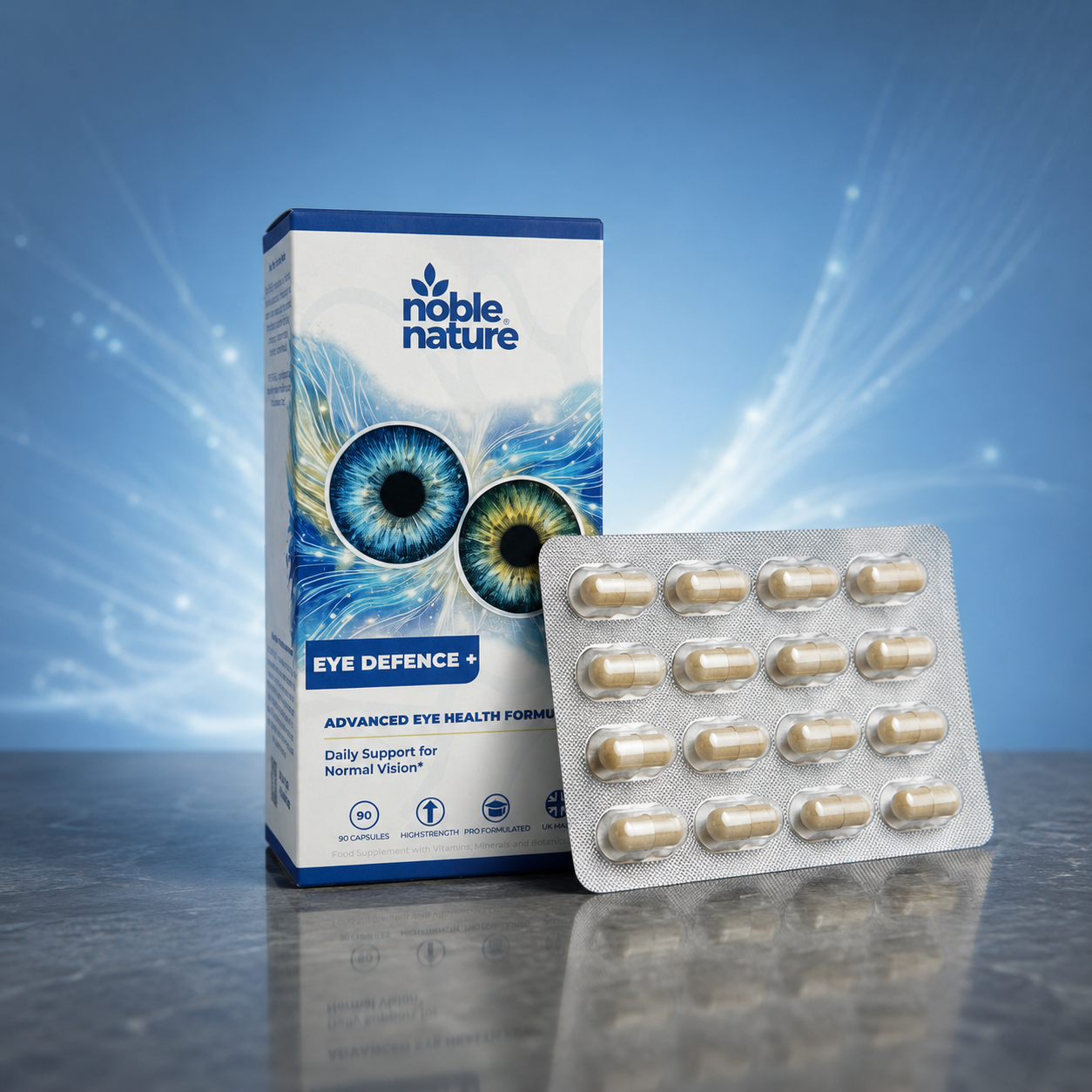
At NobleNature, we're developing an eye health formula built on exactly this evidence base the same approach we take across our range: PhD-formulated, nutritionist-reviewed, and grounded in clinical research rather than trend-driven ingredient lists. More details coming soon.
Eye health has been treated as a reactive concern for too long. The emerging science of ocular biomarkers changes that framing entirely. The retina is not just a visual organ. It is a real-time readout of how your body is ageing and one of the most accessible windows into systemic health.
The mechanisms driving ocular ageing oxidative stress, chronic inflammation, and microvascular deterioration are modifiable. The nutrients that slow them are well-evidenced. The lifestyle factors that accelerate them are largely avoidable.
The longevity case for eye health is straightforward: protect the eyes proactively, and you are protecting the biological systems they reflect. That is a worthwhile investment at any age.
Share:
Habits to Build Before You Start Supplementing