

Ashwagandha is everywhere. It is in capsules, gummies, powders, and energy drinks. Most labels say "ashwagandha extract" and leave it at that. The problem is that the phrase tells you almost nothing about what you are actually taking.
Not all ashwagandha extracts are the same. The plant part used, the extraction method, the concentration of active compounds, and the research behind the formula all vary enormously between products. When you are spending money on a supplement that is supposed to support your stress response, sleep quality, and focus, those differences matter.
KSM-66 is not a brand name for marketing purposes. It is a specific, patented, full-spectrum root extract of Withania somnifera (ashwagandha), produced to a defined standard and backed by more published clinical research than any other ashwagandha extract on the market. This article explains what that actually means, and why it changes what you should be looking for on a supplement label.
What Generic Ashwagandha Actually Means
When a supplement lists "ashwagandha extract" without any further detail, it could mean several things. The extract may come from the root, the leaves, or a combination of both. It may be standardised to a specific withanolide concentration, or it may not be standardised at all.
Withanolides are the primary bioactive compounds in ashwagandha. They are the steroidal lactones responsible for the adaptogenic effects observed in clinical trials. Without standardisation, you have no reliable way of knowing how much of these compounds are actually present in each capsule.
Why the plant part matters
The root and the leaf of the ashwagandha plant have different chemical profiles. Leaf extracts contain higher concentrations of Withaferin A and Withanone, two withanolides that are considered cytotoxic at elevated levels. Root-only extracts, by contrast, contain negligible levels of these compounds, which is why root-only formulations are generally considered the safer and better-studied option for daily supplementation.
The clinical research that most people cite when they talk about ashwagandha's effects on stress, sleep, and cognition was conducted using root-only extracts. Applying those findings to a product made from leaves or a root-leaf blend is not straightforward.
The standardisation problem
A product standardised to 1% withanolides and a product standardised to 5% withanolides are not equivalent, even at the same dose. Most well-designed clinical trials used extracts standardised to 5% withanolides at doses of 300-600 mg per day. Products that do not disclose their withanolide concentration may be delivering a fraction of what the research actually tested.
According to the US National Institutes of Health, a daily dose of 300 to 600 mg of ashwagandha root extract standardised to 5% withanolides is the range provisionally recommended by an international clinical taskforce for supporting stress resilience. That recommendation is tied to a specific extract specification, not to ashwagandha in general.
What Makes KSM-66 Different
KSM-66 is produced by Ixoreal Biomed using a proprietary extraction process that uses no alcohol or synthetic solvents. It is extracted exclusively from the root of the ashwagandha plant, and every batch is standardised to a minimum of 5% withanolides. That consistency is the foundation of its clinical credibility.
Here is how it compares to a typical unlabelled ashwagandha extract:
|
Factor |
Generic ashwagandha extract |
KSM-66 |
|---|---|---|
|
Plant part |
Root, leaf, or blend (often unspecified) |
Root only |
|
Withanolide standardisation |
Variable (often undisclosed) |
Minimum 5%, batch-verified |
|
Extraction method |
Often alcohol or chemical solvent |
Milk-based, solvent-free process |
|
Clinical trials |
Typically non-specific to the product |
32+ published gold-standard RCTs |
|
Certifications |
Varies |
46 certifications, including USDA Organic, GMP, Non-GMO, Halal, and Kosher |
|
Cytotoxic withanolides |
Levels often unknown |
Negligible Withaferin A and Withanone |
The research depth is unmatched
KSM-66 is the ashwagandha extract used in most of the clinical research that has shaped what we know about its effects. A 2021 systematic review and meta-analysis published in PLOS ONE analysed five randomised controlled trials on ashwagandha and sleep. Four of the five trials used KSM-66 specifically. The pooled data showed a statistically significant improvement in sleep quality compared with placebo, with effects most pronounced at 600 mg per day over 8 weeks or more.
The stress and cortisol data is similarly consistent. In one double-blind, placebo-controlled study, adults with a history of chronic stress who took 600 mg of KSM-66 daily for eight weeks saw:
-
A 44% reduction in perceived stress scale scores
-
A 72% reduction in anxiety scores on the Depression, Anxiety and Stress Scale
-
A 22.2% reduction in serum cortisol levels
These are not anecdotal reports. They are outcomes from controlled trials using the specific extract and dose. That is a meaningful distinction.
Consistency batch to batch
One of the practical advantages of a standardised extract is predictability. With generic ashwagandha, withanolide content can vary significantly between batches and suppliers. With KSM-66, every batch is tested to confirm it meets the 5% withanolide threshold before it leaves the facility. What you take in January should perform the same as what you take in June.
What the Label Should Tell You
Before buying any ashwagandha supplement, the label should answer three questions clearly:
-
Which part of the plant was used? Look for "root extract" or "root-only extract". If it says "root and leaf" or simply "extract" without clarification, that is a gap worth noting.
-
What is the withanolide percentage? A minimum of 5% is the benchmark used in most well-designed clinical research. Anything below 2.5% is unlikely to match the doses studied.
-
Is the extract named or verified? Branded extracts like KSM-66 have published specifications and third-party certifications. An unnamed "ashwagandha extract" has neither.
A note on dosage: The clinical research supporting ashwagandha's effects on stress and sleep consistently used doses of 300 to 600 mg per day of a root extract standardised to 5% withanolides. If a product's serving falls significantly below this range, it may not reflect what was tested.
Why NobleNature Uses KSM-66
Formulation decisions at NobleNature are made in collaboration with a PhD pharmacologist and a registered nutritionist. When it came to ashwagandha, the choice was straightforward: use the extract with the strongest, most consistent clinical evidence and the most transparent quality standards.
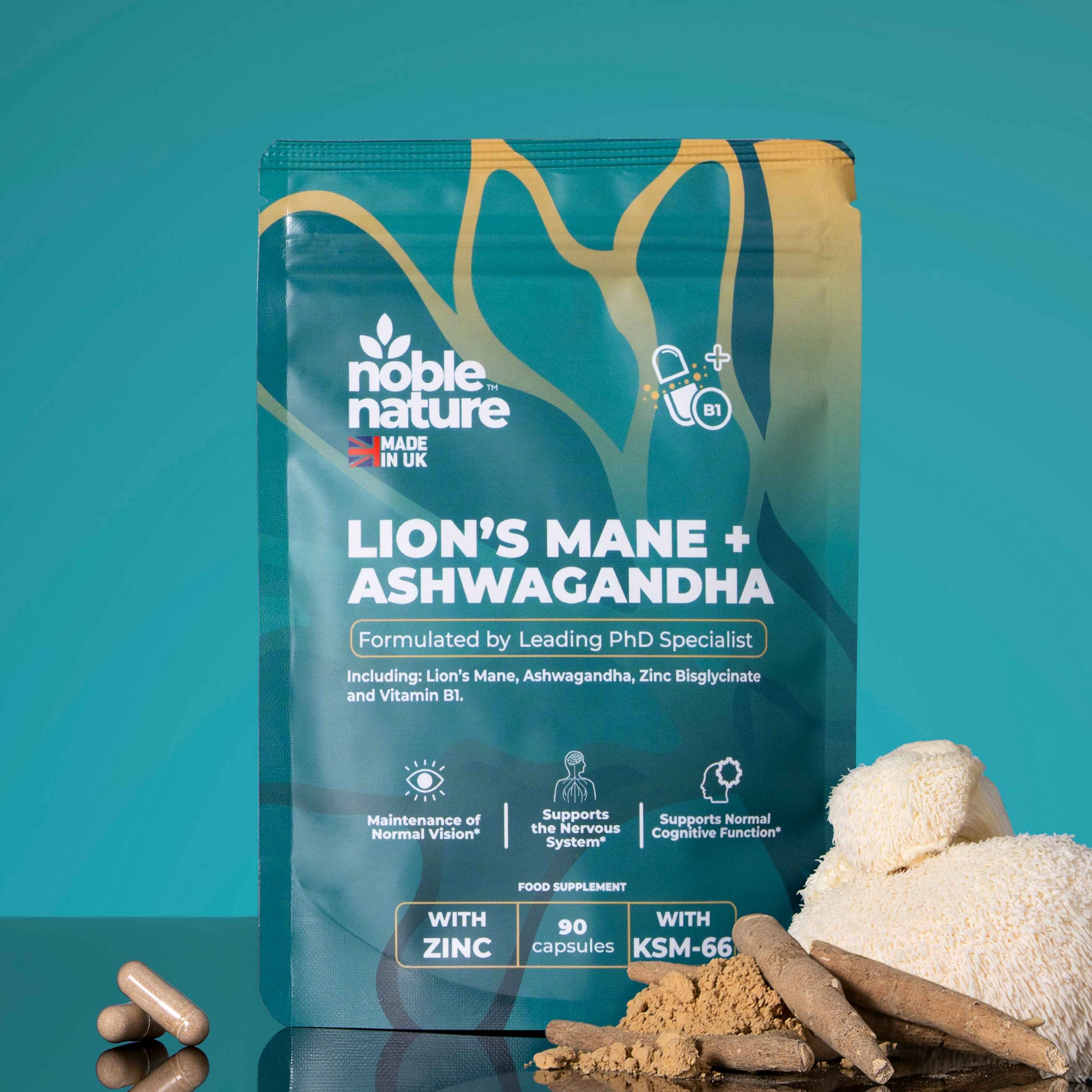
Our Lion's Mane and Ashwagandha 4-in-1 formula uses KSM-66 as the ashwagandha source. It is root-only, standardised to 5% withanolides, and manufactured in a BRCGS-certified UK facility under HACCP standards. Every batch is subject to third-party quality testing.
The formula also combines Lion's Mane mushroom, Zinc bisglycinate, and Vitamin B1. Vitamin B1 contributes to normal psychological function and normal nervous system function. Zinc contributes to normal cognitive function. These are authorised UK health claims, not marketing language.
The bottom line on ingredient choice
The supplement market is full of products that list ashwagandha on the label and say very little else. For a buyer doing proper research, that ambiguity is a red flag, not a feature.
KSM-66 resolves that ambiguity. It is a defined extract, produced to a defined standard, backed by a defined body of research. When the clinical evidence for ashwagandha is discussed in peer-reviewed literature, KSM-66 is the extract most frequently cited. That is not a coincidence.
If you are going to take ashwagandha, the extract form should be one you can actually verify. Anything less is a guess.
Explore the NobleNature formula featuring KSM-66 ashwagandha here.
Share:
Ashwagandha and Cortisol: What the Research Actually Says
Should You Take Beetroot Supplementation? Who It Actually Helps (and Who It Doesn't)