

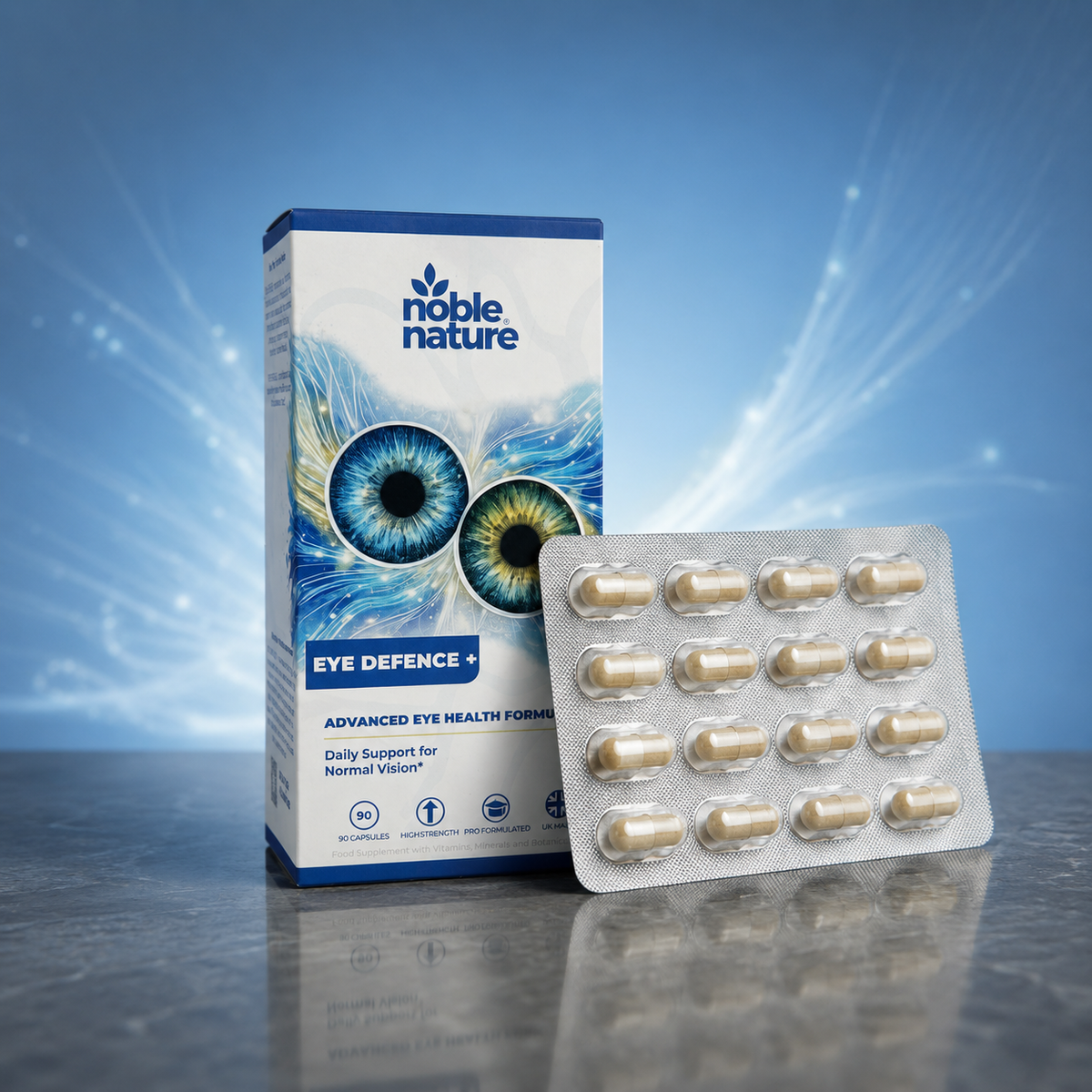
Eye health is one of those things most people don't think about until something changes. Blurry evenings. Tired eyes after a long day on screens. A gradual awareness that things aren't quite as sharp as they used to be.
The supplement market has responded with a wave of eye health products, many of which make bold claims with little transparency about what's actually inside. Eye Defence Plus takes a different approach: a focused formula built around ingredients with a genuine research base, manufactured in the UK, and formulated alongside a PhD scientist and registered nutritionist.
This article breaks down exactly what Eye Defence Plus contains, what the science says about each ingredient, and who the product is designed for.
Key ingredients at a glance: Vitamin A, Zinc, Lutein, and Zeaxanthin, combined in a single daily capsule designed to support eye health from multiple angles.
What Is Eye Defence Plus?
Eye Defence Plus is an advanced eye health supplement from NobleNature, formulated to provide nutritional support for normal vision and eye function. It combines four key ingredients: Vitamin A, Zinc, Lutein, and Zeaxanthin.
The formula is built around two core principles. First, ingredient selection is grounded in research. Second, compliance with the UK's Great Britain Nutrition and Health Claims (GB NHC) Register, which governs exactly what claims supplement brands are legally permitted to make.
Formulated with compliance in mind
Under UK law (retained from EU Regulation 432/2012), only a small number of nutrients hold authorised health claims for the "maintenance of normal vision." Eye Defence Plus is built around two of them: Vitamin A and Zinc. Both carry legally authorised claims that have been assessed and approved through rigorous scientific review.
This matters because it means the product's claims are not marketing language. They are statements that have passed regulatory scrutiny.
UK-manufactured, PhD formulated
Eye Defence Plus is produced in the UK and developed alongside a PhD scientist and registered nutritionist. For consumers who are sceptical of supplement hype, this formulation process provides a meaningful level of accountability. The ingredients are selected based on their evidence base, not on trend cycles.
The Ingredients: What Each One Does
Understanding what you're taking matters. Here is a breakdown of each ingredient in Eye Defence Plus, what the research says, and what claims are authorised under UK law.
Vitamin A: the vision nutrient with the strongest regulatory backing
Vitamin A has the most direct relationship with vision of any nutrient in this formula. Its role is specific: it is essential for producing rhodopsin, the light-sensitive pigment found in the rod cells of the retina. Rhodopsin enables vision in low-light conditions. Without adequate Vitamin A, rod cells cannot regenerate this pigment after it is bleached by light exposure.
Authorised UK health claim: Vitamin A contributes to the maintenance of normal vision.
This claim is backed by EFSA's scientific opinion on Vitamin A and is retained in UK law post-Brexit. It is not a marketing statement. It is a regulatory conclusion based on the scientific evidence.
Zinc: supporting the visual cycle from within
Zinc is found in high concentrations in the retina and the retinal pigment epithelium (RPE), the tissue layer that supports and nourishes the photoreceptor cells. Its role in the visual cycle is closely tied to Vitamin A: Zinc is essential for the activity of the enzyme that converts Vitamin A into the form the retina can actually use.
Authorised UK health claim: Zinc contributes to the maintenance of normal vision.
The two ingredients work together. Zinc helps activate Vitamin A's role in the visual cycle, which is why formulating them together is considered a decision, not an arbitrary one.
Lutein: the macular carotenoid
Lutein is a carotenoid that accumulates naturally in the macula, the central part of the retina responsible for sharp, detailed vision. Your body cannot produce lutein on its own. It must come from diet or supplementation.
Research published in the journal Progress in Retinal and Eye Research notes that lutein acts as a natural light filter in the eye, absorbing excess blue light and protecting retinal tissue from oxidative damage. A 2021 systematic review of 46 studies published in the Journal of Nutrition found that supplementation with lutein and zeaxanthin at doses above 5mg per day was associated with measurable increases in macular pigment optical density.
Important note on claims: Lutein does not currently hold an authorised UK health claim specifically for vision. The evidence base is substantial, but EFSA has not yet approved a specific claim wording. Eye Defence Plus includes lutein based on its research profile, not as a vehicle for regulatory claims.
Researchers generally reference a daily intake of 10mg of lutein as the level studied in clinical trials examining macular health.
Zeaxanthin: lutein's partner in the macula
Zeaxanthin is the second key carotenoid found in the macula, and it works alongside lutein. Together, they form the macular pigment, a protective layer that filters harmful blue light before it reaches the underlying photoreceptor cells.
A comprehensive clinical review published in PubMed Central found that higher levels of both carotenoids in eye tissue are associated with improved visual function, particularly in low light and in conditions where glare is a problem. The same review noted that randomised, placebo-controlled trials demonstrated that supplementation increases macular pigment density and may reduce the risk of progression to late age-related macular degeneration.
Clinical trials have examined the combination of 10mg lutein and 2mg zeaxanthin daily for outcomes related to macular pigment density and recovery from light-induced stress.
Like lutein, zeaxanthin does not hold an authorised UK health claim for vision. Its inclusion in Eye Defence Plus is based on the strength of the research, not on regulatory claims.
|
Ingredient |
Role in eye health |
UK authorised vision claim |
|---|---|---|
|
Vitamin A |
Produces rhodopsin for low-light vision |
Yes |
|
Zinc |
Activates Vitamin A in the visual cycle |
Yes |
|
Lutein |
Macular pigment, blue light filtration |
No (strong research base) |
|
Zeaxanthin |
Macular pigment, antioxidant protection |
No (strong research base) |
Why Combine All Four?
A reasonable question is why these four ingredients appear together rather than separately.
The answer is that they address different aspects of eye health through different biological mechanisms. Vitamin A and Zinc operate within the visual cycle itself, the biochemical process your retina uses to convert light into signals the brain can read. Lutein and Zeaxanthin operate as structural components of the macular pigment, providing a physical filter against blue light and oxidative damage.
The part most coverage misses: these mechanisms are complementary, not overlapping. Taking Vitamin A alone addresses one pathway. Adding Zinc helps that pathway function properly. Adding Lutein and Zeaxanthin addresses a separate protective layer entirely. The formula is designed to cover the breadth of nutritional support that eye health research points to, rather than doubling down on a single ingredient.
This is a common distinction between thoughtfully formulated supplements and single-ingredient products. The research on lutein and zeaxanthin, for instance, consistently examines them in combination with other nutrients. A large randomised, double-blind, placebo-controlled clinical trial involving 3,600 individuals (referenced in the AREDS research programme) found that combinations of key eye nutrients were critical for maintaining retinal and macular health. The combination is the point.
Who Is Eye Defence Plus For?
Eye Defence Plus is not a specialist medical product. It is a food supplement designed to support nutritional intake for adults who want to take a proactive approach to eye health.
It is particularly relevant for:
-
People who spend significant time on screens. Prolonged screen exposure increases the amount of blue light the eyes process daily. Lutein and zeaxanthin are the nutrients most studied in relation to blue light filtration in the retina.
-
Adults over 40. Natural antioxidant production declines with age, and the carotenoid pigments in the macula can diminish over time. Dietary intake of lutein and zeaxanthin in the UK population is typically low, often 1-2mg daily, well below the levels studied in clinical research.
-
People with low dietary intake of relevant nutrients. Lutein and zeaxanthin are found primarily in dark leafy greens such as spinach and kale, and in egg yolks. Those who do not eat these foods regularly may have a meaningful gap in their intake.
-
Anyone looking for a straightforward, compliant eye health supplement. The formula does not make exaggerated claims. It contains ingredients with documented roles in eye nutrition and is built to UK regulatory standards.
Who it is not for
Eye Defence Plus is a food supplement, not a medical treatment. It is not designed to treat, cure, or prevent any eye condition or disease. Anyone with existing eye health concerns should speak with an optometrist or GP. The product is not intended for children.
The NobleNature Approach
Eye Defence Plus reflects the way NobleNature approaches every product in its range. The formula is not built around trends or marketing angles. It is built around ingredients that have a documented role in the area being addressed, formulated at levels consistent with the research, and produced under UK manufacturing standards.
The transparency is intentional. NobleNature publishes what is in each product and why, including the distinction between ingredients with authorised UK health claims and those included based on their research profile. That distinction matters in a market where many brands blur the line between regulatory claims and general marketing language.
The bottom line: Eye Defence Plus is a four-ingredient eye health supplement built around Vitamin A, Zinc, Lutein, and Zeaxanthin. Two of those ingredients carry authorised UK health claims for normal vision. All four have a substantive research base. The formula is UK-made, PhD formulated, and designed for adults who want nutritional support for their eye health without the hype.
Share:
Recommended Daily Dose of Vitamin D3 and K2 Supplements in the UK
Beetroot vs Vitamin B12 Supplements: Benefits for Energy, Exercise, and Fatigue