

Both beetroot and vitamin B12 supplements are frequently marketed around the same broad idea: more energy, less fatigue, better performance. But they work through entirely different mechanisms, suit different people, and are backed by very different levels of evidence.
This guide cuts through the overlap and gives you a clear picture of what each supplement actually does, where the research is strongest, and which one (or both) might be worth adding to your routine.
The short answer: Vitamin B12 has robust, authorised health claims for fatigue reduction and is essential for normal energy metabolism. Beetroot works differently, supporting blood flow and exercise efficiency through nitric oxide production. They are not interchangeable.
What Does Vitamin B12 Actually Do?
Vitamin B12 (cobalamin) is an essential nutrient your body cannot produce on its own. It plays a central role in red blood cell formation, nervous system function, and energy metabolism at the cellular level.
A deficiency in B12 has been associated with extreme tiredness, lack of energy, muscle weakness, and psychological difficulties ranging from low mood to cognitive problems. These are well-documented consequences of inadequate B12 status, recognised by clinical and regulatory bodies, including the NHS.
Authorised Health Claims for Vitamin B12
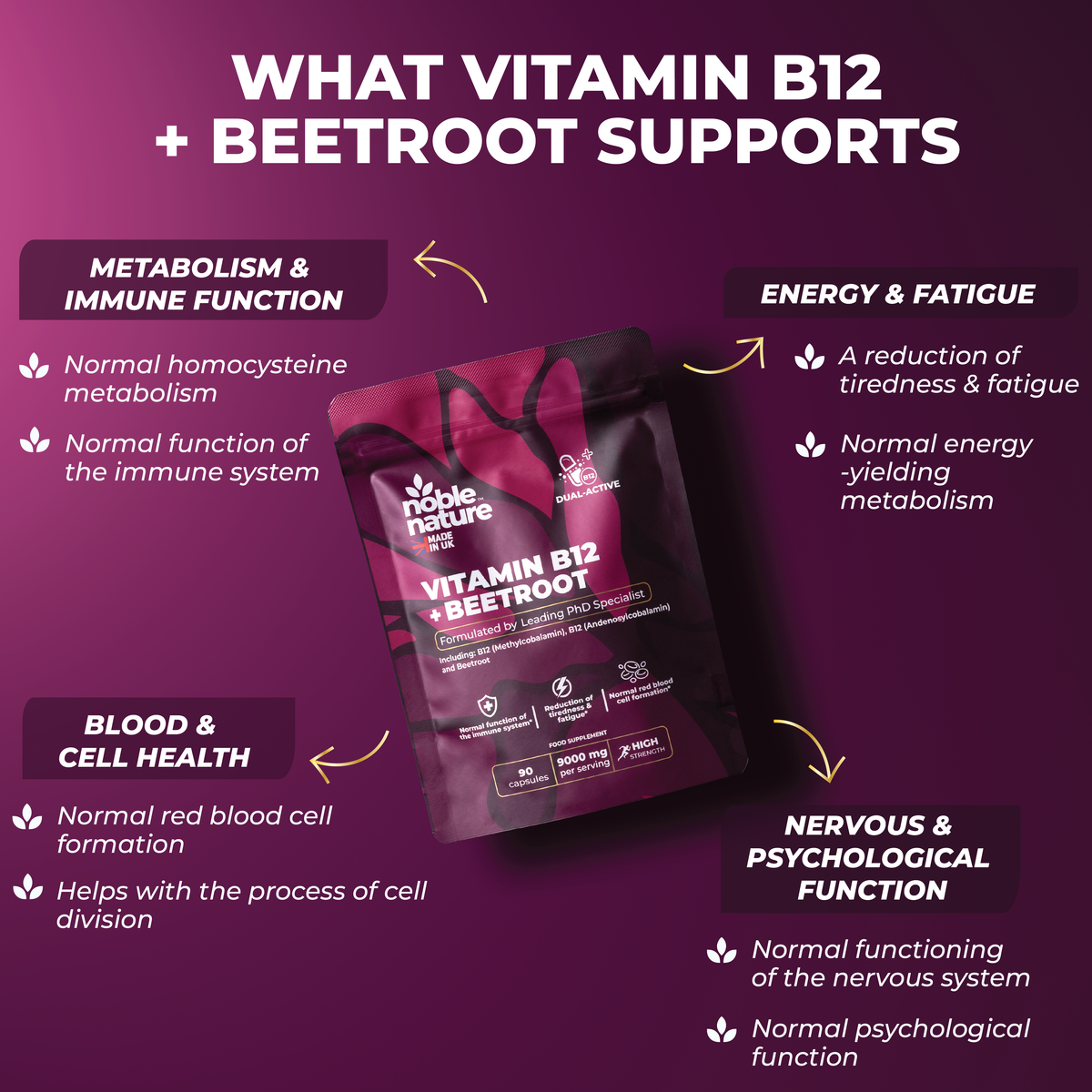
In the UK, the following health claims for vitamin B12 are authorised and backed by the European Food Safety Authority (EFSA):
-
Contributes to normal energy-yielding metabolism
-
Contributes to the reduction of tiredness and fatigue
-
Contributes to normal psychological function
-
Contributes to normal functioning of the nervous system
-
Contributes to normal red blood cell formation
-
Contributes to normal homocysteine metabolism
These are not marketing phrases. They are scientifically substantiated claims that supplement brands are legally permitted to make on product labelling and communications in the UK.
Who Is Most at Risk of Deficiency?
B12 deficiency is more common than many people realise. Analysis of NHS prescribing data suggests B12 deficiency may affect around 6% of people under 60 in the UK and approximately 20% of those aged 60 and over. In 2023/24, there were 38,140 courses of NHS treatment involving people with vitamin B12 deficiency anaemia.
Groups at higher risk include:
-
Vegans and vegetarians (B12 is found almost exclusively in animal products)
-
Older adults (absorption declines with age)
-
People taking certain medications, including proton pump inhibitors (PPIs) and metformin
-
Those with digestive conditions that affect nutrient absorption
If you fall into any of these categories and are experiencing persistent fatigue, B12 is the supplement to investigate first.
What Does Beetroot Supplement Do?
Beetroot is a rich source of inorganic nitrate, a compound that the body converts into nitric oxide (NO). Nitric oxide relaxes and widens blood vessels, improving blood flow and the delivery of oxygen to working muscles. This is the core mechanism behind beetroot's reputation as a performance supplement.
The key distinction: beetroot does not correct a deficiency. It provides a functional input that can support physical performance in people who are already healthy. That is a fundamentally different role from B12.
Beetroot and Exercise Performance
The research on beetroot and exercise is genuinely promising, particularly for endurance activities. Research analysing multiple studies has indicated that beetroot juice supplementation may improve cardiorespiratory endurance by increasing exercise efficiency, extending time to exhaustion at submaximal intensities, and improving VO2max performance.
Further evidence has suggested that beetroot juice may offer advantages over isolated nitrate supplementation, specifically in reducing oxygen consumption during high-intensity exercise and supporting recovery from muscle-damaging exercise. The polyphenols present in whole beetroot appear to work in conjunction with nitrate rather than independently, though more research is needed to confirm the extent of this effect.
However, it is worth being clear about the limits. Results vary considerably depending on:
|
Factor |
Why It Matters |
|---|---|
|
Training status |
Untrained individuals tend to see larger effects than elite athletes |
|
Exercise type |
Endurance activities benefit most; explosive or anaerobic work shows less consistent results |
|
Dose and timing |
Research typically uses 300-500mg of nitrate, taken 2-3 hours before exercise |
|
Individual variation |
Some people are non-responders due to oral microbiome differences |
Beyond Exercise: Other Potential Benefits
The evidence for beetroot extends beyond sport. Evidence has suggested that beetroot supplementation may be associated with reduced blood pressure, antioxidant protection from its betalain pigments, and anti-inflammatory effects. These benefits are more relevant to general wellness rather than acute performance.
That said, beetroot carries no authorised Article 13 health claims in the UK in the way B12 does. Its benefits are supported by research, but they sit in a different regulatory category.
Beetroot vs Vitamin B12: A Side-by-Side Comparison
These two supplements are often grouped together in energy and wellness marketing, but they target very different problems. Here is how they compare across the areas that matter most.
|
|
Beetroot |
Vitamin B12 |
|---|---|---|
|
Primary mechanism |
Increases nitric oxide via dietary nitrate |
Supports red blood cell formation and energy metabolism |
|
Best suited for |
Exercise performance, endurance, and blood flow |
Fatigue from deficiency, neurological support, and daily energy |
|
Evidence base |
Strong for endurance exercise; emerging for wider health |
Robust; authorised UK health claims backed by EFSA |
|
Corrects a deficiency? |
No |
Yes, when B12 status is low |
|
Regulatory claims (UK) |
No authorised Article 13 claims |
Multiple authorised claims, including fatigue reduction |
|
Who benefits most |
Active individuals, endurance athletes, and those supporting cardiovascular health |
Vegans, older adults, those with absorption issues, and anyone experiencing unexplained fatigue |
|
Onset of effect |
Acute effects within 2-3 hours of supplementation |
Gradual improvement over weeks as the deficiency resolves |
The "Energy" Overlap Explained
The reason these supplements are often compared is that both can influence how energised you feel, just through different routes. Beetroot improves the efficiency of oxygen use during exercise, so physical effort feels less taxing. B12 addresses the upstream problem: if your body cannot form red blood cells properly or run its metabolic pathways efficiently, fatigue follows regardless of how well-oxygenated your muscles are.
The practical implication: if your fatigue is persistent, daily, and not specifically tied to exercise, B12 is the more likely candidate. If your goal is improving performance during workouts or supporting endurance, beetroot is the more targeted choice.
Can You Take Beetroot and Vitamin B12 Together?
Yes, and for many people this combination makes sense. They do not compete or interact negatively. They address different physiological pathways, which means stacking them is logical rather than redundant.
A sensible approach for someone active and also concerned about fatigue would be:
-
Vitamin B12 daily to support baseline energy metabolism, neurological function, and red blood cell formation
-
Beetroot supplement taken before training to support blood flow, oxygen efficiency, and endurance performance
This is not a case of "more is always better." It is a case of using each supplement for the specific job it is designed to do. If you are not particularly active and your primary concern is persistent tiredness, B12 alone is the more evidence-backed starting point. If you are training regularly and your energy levels are generally fine, beetroot may offer more targeted value.
A note on quality: The effectiveness of both supplements depends heavily on formulation. For beetroot, the nitrate content of the supplement matters significantly. For B12, the form used (methylcobalamin vs cyanocobalamin) and the dose affect how well it is absorbed and utilised by the body.
Frequently Asked Questions
Does beetroot give you more energy?
Beetroot does not directly boost energy in the way a stimulant would. It supports exercise efficiency by increasing nitric oxide production, which improves blood flow and oxygen delivery to muscles. This can make physical effort feel less demanding and extend endurance, but it is not the same as correcting an energy deficiency.
Is vitamin B12 good for fatigue?
Vitamin B12 carries an authorised UK health claim for contributing to the reduction of tiredness and fatigue. This claim applies specifically when B12 status is adequate or being restored. If your fatigue is caused by B12 deficiency, supplementation can make a meaningful difference. If your B12 levels are already normal, additional supplementation is unlikely to have a noticeable effect on energy.
How long does it take for vitamin B12 to work?
If you are addressing a deficiency, improvement in fatigue and energy levels typically takes several weeks of consistent supplementation. B12 is not an acute supplement in the way beetroot can be used pre-workout.
Does beetroot lower blood pressure?
Research does suggest beetroot supplementation can support healthy blood pressure through its nitrate content and the resulting increase in nitric oxide. However, if you have a diagnosed blood pressure condition, you should speak with your GP before using beetroot supplements.
Which is better: beetroot or vitamin B12?
Neither is universally "better." They serve different purposes. Vitamin B12 is essential for normal body function and addresses a genuine deficiency risk. Beetroot is a functional performance supplement with strong evidence for endurance exercise. The right choice depends on your goals and your current nutritional status.
The Bottom Line
Beetroot and vitamin B12 are both legitimate supplements with real evidence behind them. But they are solving different problems, and conflating them leads to poor purchasing decisions.
Vitamin B12 is foundational. It is essential for normal energy metabolism, nervous system function, and red blood cell formation. With B12 deficiency affecting an estimated 6% of under-60s and 20% of over-60s in the UK, it is a supplement with genuine population-level relevance, particularly for vegans, older adults, and anyone experiencing unexplained fatigue.
Beetroot is targeted. Its nitrate content supports nitric oxide production, which improves blood flow and exercise efficiency. The evidence is strongest for endurance performance, and its effects are more acute and exercise-specific than B12's systemic role.
If you are unsure where to start, assess your diet and any risk factors for B12 deficiency first. If persistent fatigue is your primary concern, B12 is the more directly relevant supplement. If you are already energised and want to support training performance, beetroot is worth exploring.
Both supplements are most effective when formulated properly and dosed appropriately. At NobleNature, every product is developed alongside a PhD scientist and registered nutritionist, manufactured in the UK, and supported by third-party lab testing, so you know exactly what you are getting.
Share:
Eye Defence Plus: What It Is, What's In It, and Who It's For
Why Might People Consider Taking an Eye Defence Supplement?