

What Makes This Formula Worth Explaining
If you are comparing beetroot and vitamin B12 supplements, you are probably not just looking for the cheapest option. You are trying to work out whether a product has been put together properly, or whether it is simply a label with a few recognisable ingredient names and a lot of marketing language.
That distinction matters because the supplement market contains both. Separating one from the other means looking past the front-of-pack claims and into the formulation decisions themselves.
Here is what a credible supplement formula is built on:
-
Ingredient form - not just what is included, but which form of each ingredient, and why
-
Combination logic - whether the ingredients work sensibly together for a defined daily-use purpose
-
Dosage and delivery - how the formula is presented and whether the format supports consistent use
-
Manufacturing standard - where and how the product is made, and what quality controls apply
-
Claim discipline - whether the brand communicates benefits accurately within UK regulatory boundaries
This page explains how NobleNature approaches each of those areas in its Vitamin B12 and Beetroot supplement, so you can assess the formulation on its own terms.
The Core Formulation: Beetroot Plus Two Bioactive Forms of Vitamin B12
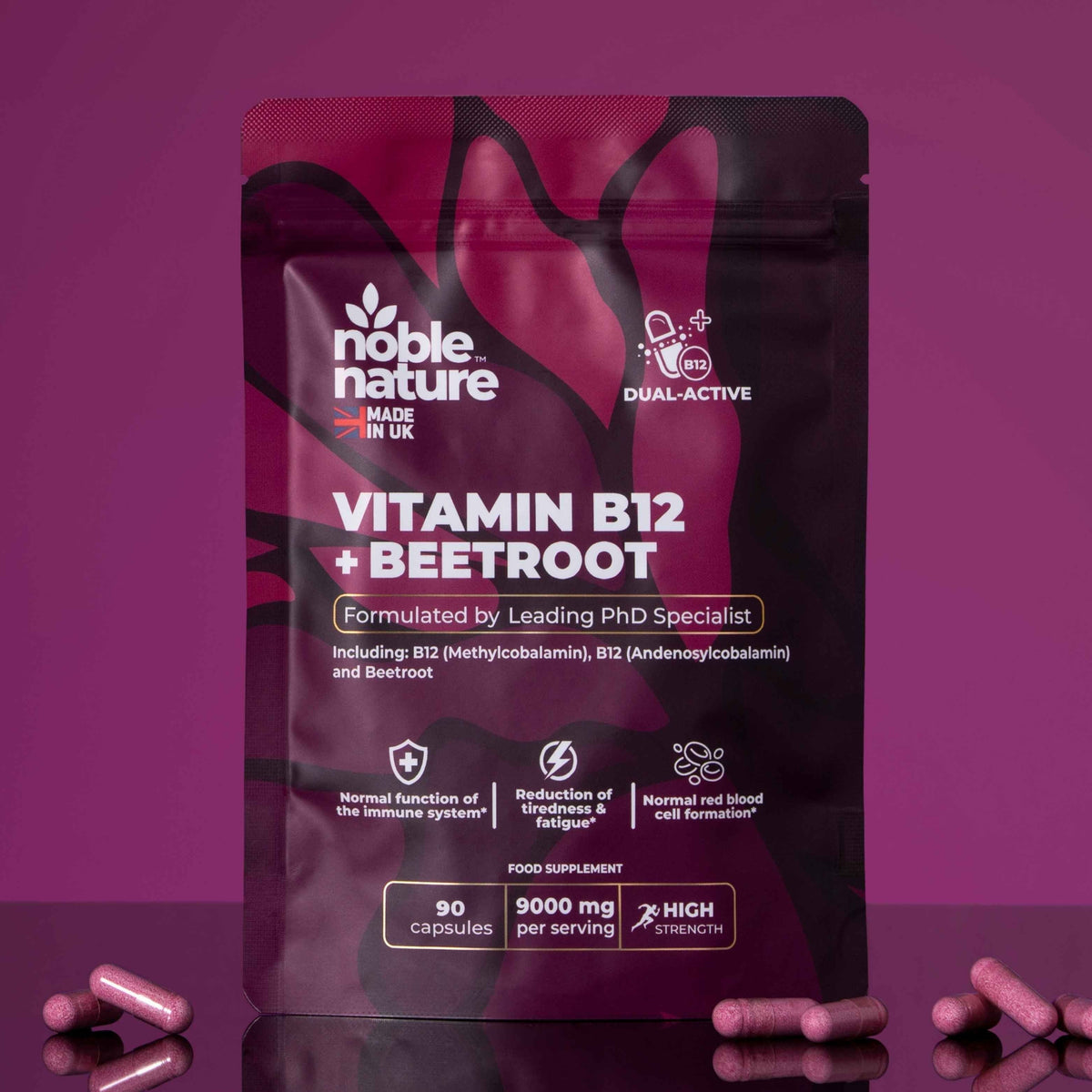
NobleNature's Vitamin B12 and Beetroot supplement combines three ingredients in a single daily capsule: beetroot, methylcobalamin, and adenosylcobalamin. The decision to use two distinct forms of vitamin B12, rather than one generic B12 inclusion, is the most significant formulation choice in this product and the one that most clearly signals a considered approach.
Many B12 supplements list "vitamin B12" without specifying the form. NobleNature names both forms explicitly, which is useful if you know what to look for, and a reasonable quality indicator if you are still learning what to look for.
This is a daily nutritional supplement, not a stimulant, a performance product, or a treatment for any condition. The combination gives you a straightforward, consistent daily intake of beetroot alongside two active B12 forms.
Ingredient Overview
|
Ingredient |
Form |
Role in Formula |
|---|---|---|
|
Vitamin B12 |
Methylcobalamin |
Active coenzyme form; contributes to the authorised B12 claim territory |
|
Vitamin B12 |
Adenosylcobalamin |
Second active coenzyme form; broadens the B12 profile |
|
Beetroot |
Whole root extract |
Natural source of dietary nitrates; supports the complementary positioning of the formula |
The dual-B12 approach reflects a deliberate effort to go beyond a minimum-viable formulation. Using two active forms rather than one gives the product a more considered ingredient profile, without requiring exaggerated claims to justify the decision.
Why Vitamin B12 Form Matters
The form of vitamin B12 in a supplement is one of the clearest signals of how seriously a brand has approached its formulation. If you compare products closely, you will notice the market presents a wide range of specificity.
What Shoppers Often See vs What NobleNature Specifies
|
What Shoppers Often See |
What NobleNature Specifies |
|---|---|
|
"Vitamin B12" with no further details |
Methylcobalamin, named explicitly |
|
Cyanocobalamin is listed as the sole B12 source |
Adenosylcobalamin is listed alongside methylcobalamin |
|
No explanation of why a particular form was chosen |
Two active coenzyme forms were selected as a deliberate formulation decision |
|
B12 included at a token level without context |
B12 forms are presented as central to the product's nutritional rationale |
Methylcobalamin and adenosylcobalamin are both active coenzyme forms of vitamin B12. This means they are forms the body uses directly in cellular processes, rather than forms that require conversion steps before use. That distinction is worth understanding, though it should not be overstated: the body is capable of processing multiple B12 forms, and the research landscape around comparative absorption is still developing.
What the dual-form approach does signal clearly is product intent. A brand that lists two named active B12 forms is making a transparent formulation statement, inviting you to look at the ingredient choices rather than just the headline benefit claims. If you are comparing supplements on formulation quality rather than price alone, that transparency is a meaningful differentiator.
Why Include Beetroot in the Same Formula
Beetroot is a well-recognised vegetable with a substantial body of research interest, much of it centred on its dietary nitrate content. When consumed, dietary nitrates are converted to nitric oxide in the body, a compound involved in vascular function. That pathway is the scientific basis for most of the research interest in beetroot as a nutritional ingredient.
What the research does and does not show: A meta-analysis published in the Journal of Nutrition found that inorganic nitrate and beetroot juice supplementation were associated with a pooled reduction of 4.4 mmHg in systolic blood pressure across 16 trials. A separate seven-study meta-analysis focused specifically on hypertensive patients found a similar effect. The evidence in this area is more consistent than in some others. The evidence in this area is more consistent than in some others. Claims about beetroot improving exercise performance, energy levels, or circulation in broader, everyday terms are less well-supported by the current body of evidence and should be treated with more caution.
What Beetroot Brings to This Formula
-
A source of dietary nitrates from a whole food ingredient
-
Complementary positioning alongside vitamin B12 for a daily nutritional support product
-
A recognisable, food-derived ingredient that fits a transparent, ingredient-led approach
The decision to pair beetroot with vitamin B12 is not arbitrary. Vitamin B12 contributes to normal energy-yielding metabolism and to the reduction of tiredness and fatigue, per UK authorised claims. Beetroot adds a complementary ingredient dimension without requiring the formula to make overlapping or exaggerated claims.
The combination positions this as a daily nutritional supplement grounded in two well-documented ingredients, each included for a defined reason rather than for marketing appeal alone.
Delivery Format, Daily Use, and Practical Design Choices
The formula is presented in capsule form. That is a deliberate choice with practical implications that are worth considering alongside the ingredient decisions.
Format Considerations
Capsules vs alternatives:
|
Format |
Consideration |
|---|---|
|
Capsule (NobleNature) |
Fixed dose, no preparation, consistent daily use |
|
Beetroot juice or powder |
Variable nitrate content depending on source and processing; preparation required |
|
Tablet |
Can include binders and fillers that increase tablet size and complexity |
A 90-capsule pack is designed to cover a multi-month supply at a standard daily dose. That pack size signals a product built for sustained, routine use rather than a short-term trial format.
Why is format part of formulation quality:
Consistency matters. A supplement that is inconvenient to take tends not to be taken consistently, which undermines any nutritional benefit the formula might otherwise support. Capsule format removes that friction from your daily routine.
If a formula is designed around daily nutritional support, the delivery method needs to support daily use. NobleNature's capsule format does that without unnecessary complexity.
Manufacturing Standards Are Part of the Formulation Story
Ingredient selection is only one part of what makes a supplement credible. The other part is how the product is manufactured, tested, and quality-controlled before it reaches the customer.
NobleNature states that its supplements are produced in the UK in a Class 7 pharmaceutical-grade facility. That classification refers to a controlled cleanroom environment with defined standards for airborne particulate contamination, which is a more rigorous production setting than many food-grade supplement manufacturers operate within.
What the Manufacturing Standard Signals
-
UK production - subject to UK food supplement regulations and MHRA oversight of the manufacturing environment
-
Class 7 pharmaceutical facility - a controlled cleanroom standard typically associated with pharmaceutical manufacturing, applied here to supplement production
-
PhD-led formulation - the formula is developed alongside a PhD scientist, adding a layer of scientific scrutiny to ingredient and dosage decisions
-
Registered nutritionist involvement - formulation is also reviewed by a registered nutritionist, providing a practical dietary context alongside the scientific input
-
Third-party lab testing - independent verification of the finished product, rather than relying solely on in-house quality checks
Each of these factors is a process decision, not a marketing claim. A brand that invests in this level of manufacturing and oversight is making a statement about where it places quality in its priorities.
Why Compliance Is Part of a Better Supplement Formula
In the UK, supplement brands are legally required to use only authorised nutrition and health claims. The Great Britain nutrition and health claims register sets out precisely which claims are permitted, and in what form they may be used. Brands that overreach those boundaries are not just bending the rules; they are usually overstating what the evidence actually supports.
Vitamin B12 has a well-established set of authorised claim areas under UK regulations. NobleNature communicates within those boundaries.
Authorised Vitamin B12 Claims: What Compliant Communication Looks Like
|
Compliant Approach |
Non-Compliant Approach |
|---|---|
|
"Vitamin B12 contributes to normal energy-yielding metabolism" |
"Boosts your energy levels" |
|
"Contributes to the reduction of tiredness and fatigue" |
"Eliminates fatigue" or "gives you all-day energy" |
|
"Contributes to normal red blood cell formation" |
"Improves your blood health" |
|
"Contributes to normal immune system function" |
"Strengthens your immune system" |
|
Describing what the ingredient does within normal physiological function |
Implying treatment, cure, or disease prevention |
The discipline to stay within authorised claim language is not a limitation. It is a sign that a brand understands the difference between what an ingredient contributes to in the context of a balanced diet and what a drug can be licensed to treat. That distinction matters for consumer trust, and it matters for regulatory standing.
If a brand is willing to overstate what its product does, it is worth asking: what else are they willing to overstate?
How to Judge Whether This Supplement Is Right for You
The formulation decisions outlined above add up to a product with a clear profile. Whether it is the right fit depends on what you are looking for in a beetroot and B12 supplement.
Is This the Right Supplement for You?
This product is likely a good fit if you:
-
Want a supplement that names its B12 forms clearly, rather than listing generic "vitamin B12"
-
Value a dual-form B12 approach (methylcobalamin and adenosylcobalamin) as a formulation signal
-
Want a daily capsule format that is straightforward to take consistently
-
Want a UK-manufactured product made to pharmaceutical-grade facility standards
-
Prefer a brand that communicates benefits within UK authorised claim boundaries, rather than overstating what the product does
-
Are interested in a beetroot-inclusive formula grounded in its dietary nitrate content, without exaggerated performance or energy claims
This product is less likely to be the right fit if you are looking for a high-dose standalone B12 supplement, a beetroot product specifically formulated around exercise performance, or a product with a wider multi-ingredient stack.
Review the full label and formulation details on the NobleNature Vitamin B12 and Beetroot product page. The ingredient list, dosage information, and usage guidance are all available there so you can make an informed decision on your own terms.
Share:
How Do Ashwagandha Supplements Work? What the Evidence Actually Shows
Does Ashwagandha Actually Reduce Anxiety and Stress? Here's What the Research Shows