

Lutein is probably the ingredient most people notice first when they read the label on an eye health supplement. It sounds scientific, it appears in most of the well-known eye nutrition products, and it comes up constantly in conversations about screen time and long-term eye health.
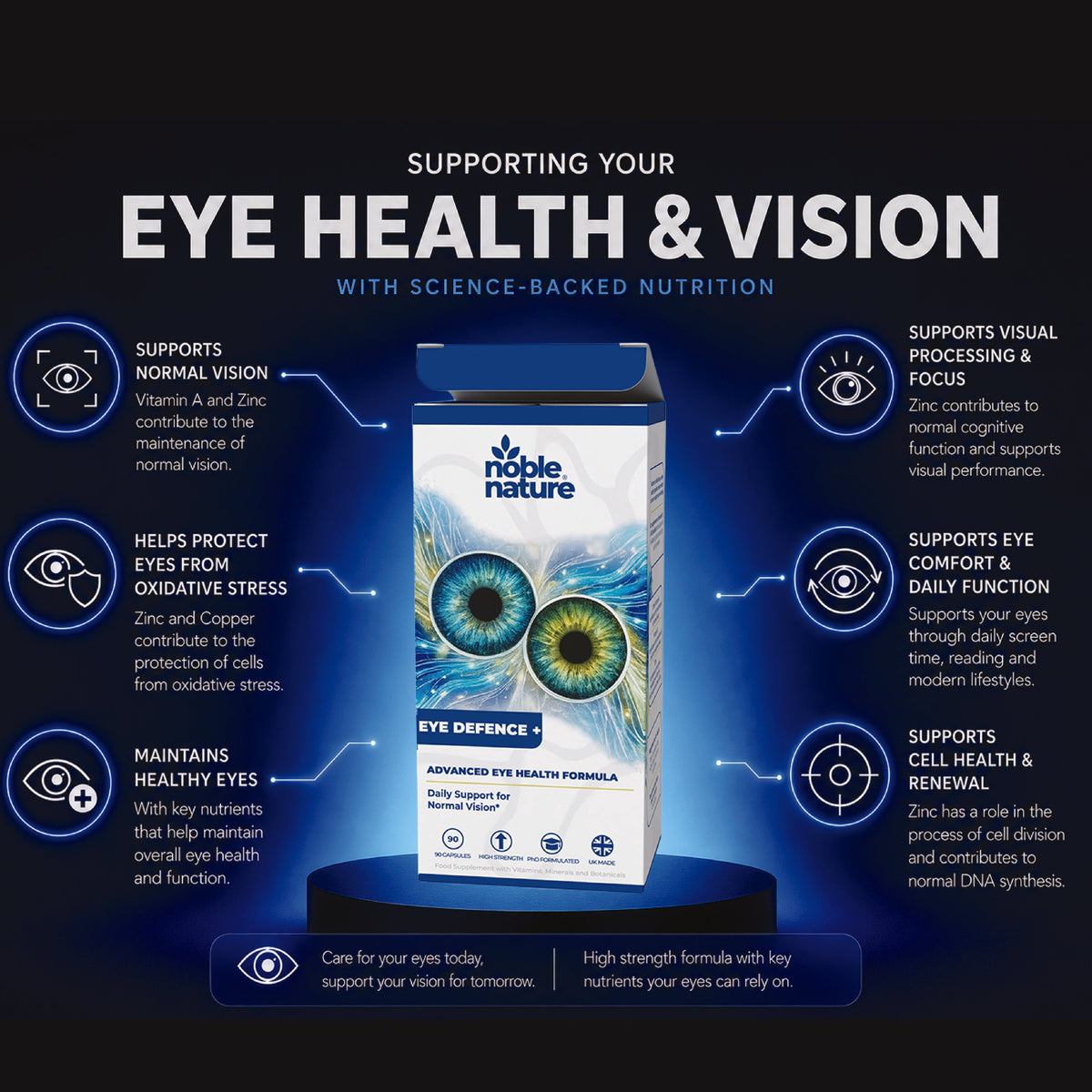
But what does it actually do? And why does a formula like Eye Defence Plus include it alongside vitamin A and zinc rather than leading with it as the headline claim?
This article answers both questions honestly, starting with what lutein is, moving through the research, and explaining how it fits into a formula built around authorised UK health claims.
What Is Lutein?
Lutein is a carotenoid, a class of natural pigments found in plants and eggs. The body cannot produce it on its own, so it must come from food or supplementation.
In the body, lutein concentrates in specific tissues, most notably the macula. The macula is the central area of the retina responsible for sharp, detailed vision, and it is where lutein is found in the highest concentrations, alongside a closely related carotenoid called zeaxanthin.
Key facts about lutein:
-
Found naturally in dark leafy greens (kale, spinach, broccoli), egg yolks, and sweetcorn
-
Classified as a xanthophyll carotenoid, distinct from beta-carotene
-
Concentrated in the macula and lens of the eye
-
Cannot be synthesised by the human body
-
Has no standalone authorised health claim for vision under UK regulations
That last point matters. Consumer interest in lutein is driven by the research around macular pigment and antioxidant activity in the retina, not by a regulatory approval equivalent to those held by vitamin A or zinc. Understanding that distinction is the starting point for evaluating any eye supplement that includes it.
Why Lutein Gets So Much Attention in Eye Health
Lutein's presence in the macula is the reason it appears in so many eye health formulas. Researchers have studied two main mechanisms that may explain its relevance to eye nutrition.
|
Mechanism |
What it means in practice |
|---|---|
|
Macular pigment contribution |
Lutein and zeaxanthin are the primary components of macular pigment. Higher macular pigment optical density (MPOD) has been associated with filtering high-energy blue light before it reaches the photoreceptors beneath. |
|
Antioxidant activity in the retina |
The retina is metabolically active and exposed to light, making it susceptible to oxidative stress. Lutein has antioxidant properties that have been studied in the context of retinal tissue protection. |
Both mechanisms are biologically plausible and have been explored in peer-reviewed research. Studies measuring MPOD have shown that lutein and zeaxanthin intake from diet and supplementation can increase macular pigment levels in humans, as documented in this systematic review and meta-analysis via PMC.
The important distinction: a plausible mechanism and a measurable biological effect are not the same as an authorised health claim. The UK regulatory framework requires a higher standard of evidence before a specific claim about vision can be made on a product label. Lutein has not cleared that bar, which is why responsible supplement brands explain the research context rather than making direct vision claims.
What the Research Actually Says
The most significant clinical reference point in this category is the Age-Related Eye Disease Study 2 (AREDS2), a large randomised trial funded by the US National Eye Institute that studied the effect of lutein and zeaxanthin in an established eye health supplement formulation. A 2022 review published in PMC via the National Institutes of Health summarises the key findings and their implications for supplementation.
What AREDS2 found: The primary analysis did not demonstrate a statistically significant added benefit of lutein and zeaxanthin on the overall progression endpoint. However, secondary analyses showed that progression from dry AMD to advanced AMD was 31% lower in the lutein and zeaxanthin group compared to placebo. These results supported lutein and zeaxanthin as a more appropriate replacement for beta-carotene in AREDS-type formulas, particularly for smokers and former smokers, for whom beta-carotene carries a separate risk concern.
A systematic review and meta-analysis published via PMC, covering 46 randomised and non-randomised trials, found that daily doses of lutein and zeaxanthin above 5mg for at least three months can increase macular pigment optical density (MPOD) in adults with healthy eyes, with a dose-response relationship observed at higher intakes.
The honest interpretation of this evidence is nuanced:
-
Lutein and zeaxanthin have a serious, peer-reviewed evidence base in the context of eye nutrition research
-
The AREDS2 trial population was adults with existing age-related macular changes, not the general consumer market
-
The results support lutein's inclusion in a well-formulated eye supplement, but do not support claims of prevention or treatment for the general population
-
The MPOD research in healthy adults is promising but the clinical significance of MPOD changes is still being established
The takeaway for supplement shoppers: lutein is not a marketing invention. It has a credible scientific rationale and a meaningful clinical research trail. But the evidence is specific in its context, and any brand that presents it as a guaranteed vision solution is going beyond what the research supports.
Where Vitamin A and Zinc Fit In
This is where Eye Defence Plus differs from formulas that rely entirely on lutein's research appeal. Vitamin A and zinc both carry authorised health claims under UK retained food law, specifically for the maintenance of normal vision.
|
Ingredient |
Role in the formula |
UK claims status |
|---|---|---|
|
Vitamin A |
Contributes to normal vision, including in low-light conditions |
Authorised UK health claim |
|
Zinc |
Contributes to the maintenance of normal vision |
Authorised UK health claim |
|
Lutein |
Research-led inclusion contributes to macular pigment |
No standalone authorised vision claim |
|
Zeaxanthin |
Research-led inclusion; found alongside lutein in the macula |
No standalone authorised vision claim |
The authorised claims for vitamin A and zinc are set out under UK retained Regulation (EC) No 1924/2006 and administered by the Food Standards Agency. These are not marketing statements. They reflect a regulatory determination that the evidence base for these nutrients and normal vision function meets the required standard.
Including vitamin A and zinc gives Eye Defence Plus a claimable foundation. The lutein and zeaxanthin inclusion reflects formulation logic grounded in the research literature, not an attempt to make claims the regulatory framework does not support.
Why Eye Defence Plus Uses This Combination
Most eye supplements take one of two approaches: they either lead entirely with lutein and zeaxanthin, leaning on the research interest without a claimable foundation, or they include only the authorised nutrients and miss the research context entirely.
Eye Defence Plus is built around a different logic:
-
Vitamin A and zinc provide the authorised claims framework, meaning the product can legitimately state that it contributes to the maintenance of normal vision
-
Lutein and zeaxanthin are included because the peer-reviewed research on macular pigment and retinal antioxidant activity makes them a rational part of an eye nutrition formula
-
The combination reflects how a PhD-formulated product should be structured: claimable where the regulations permit, research-led where they do not
In short: Eye Defence Plus does not overclaim lutein. It includes it because the science supports its presence in an eye health formula, while vitamin A and zinc carry the regulatory weight for vision-related claims.
This approach is more conservative than some competitors. It is also more honest, and for shoppers who read labels carefully, that matters.
Who This Supplement May Suit
Eye Defence Plus is not positioned as a treatment or a cure for any eye condition. It is a nutritional supplement formulated around eye health nutrients with authorised UK claims and a research-led ingredient selection.
It may be a good fit for:
-
Adults who spend significant time on screens and want an evidence-led eye nutrition formula as part of a broader health routine
-
People comparing eye supplements who want vitamin A and zinc included for their authorised normal-vision claims
-
Shoppers who want to understand exactly what is in a formula and why, rather than taking marketing language at face value
-
Adults who have low dietary intake of lutein-rich foods such as leafy greens and eggs
It is not a substitute for a balanced diet, regular eye examinations, or medical advice. Anyone with an existing eye condition or taking medication should speak to a qualified healthcare professional before starting any supplement.
The Bottom Line on Lutein
Lutein is worth understanding. It has a serious scientific rationale, a meaningful clinical research trail, and a clear biological role in the eye. What it does not have is an authorised UK health claim for vision, which is why honest supplement brands explain the research rather than making promises the regulations do not permit.
Key takeaways:
-
Lutein concentrates in the macula and has been studied for its role in macular pigment and retinal antioxidant activity
-
AREDS2 is the most cited clinical reference, and its findings support lutein's inclusion in eye nutrition formulas without overstating the results
-
Vitamin A and zinc are the authorised ingredients in Eye Defence Plus for normal vision claims
-
The combination of all four ingredients reflects a formulation approach that is both research-led and compliance-disciplined
If you want a straightforward eye health supplement explained properly, without the hype, Eye Defence Plus is available at noblenature.co.uk.
Share:
Why Might People Consider Taking an Eye Defence Supplement?
Ashwagandha With Black Pepper or Without: Which Is Better?