

Most runners who try beetroot before a Parkrun take it too late. A shot 20 minutes before the start, or a capsule swallowed on the way to the park, puts you firmly outside the window where the evidence says it works.
The timing question is actually well-researched. Here is what the science says, translated into a protocol you can use this Saturday.
The short answer: take your beetroot supplement 2 to 3 hours before your Parkrun starts. Not 30 minutes. Not the night before. Two to three hours.
Why the Timing Window Matters
Beetroot works because it is rich in dietary nitrate. Once ingested, nitrate is converted by bacteria in your mouth and gut into nitrite, which is then converted into nitric oxide (NO) in the bloodstream. Nitric oxide widens blood vessels, improves oxygen delivery to working muscles, and reduces the oxygen cost of effort at a given pace.
The problem is that this conversion process takes time.
According to research published in the journal Nutrients (2025), plasma nitrate levels peak 1 to 2 hours after ingestion, and plasma nitrite (the more active compound) peaks at 2 to 3 hours. That is your performance window. Arriving at the start line before that window opens means the nitric oxide simply is not there yet.
This is not theoretical. A 2011 PubMed RCT (Med Sci Sports Exerc, PMID 21471821) had club cyclists take beetroot juice 2.5 hours before a 4km time trial and improved performance by 2.8% compared to placebo. The timing in that study maps almost exactly onto the nitrite peak, and the results reflect it.
This is why the same umbrella review, which analysed data across multiple randomised controlled trials, concluded that acute supplementation taken 2 to 3 hours before exercise produces statistically significant improvements in physical performance compared to placebo.
What "significant" actually means for a 5K
The honest answer is: the effect is real but modest. A 2020 meta-analysis published in PMC covering 80 randomised trials found an average ergogenic effect of around 3% across exercise modalities.
For a 25-minute Parkrun, that translates to roughly 45 seconds. For a 22-minute runner chasing a sub-20, it is closer to 40 seconds.
That is not a miracle. But it is meaningful, repeatable, and free of banned substances. In the context of chasing a PB, 40 seconds is nothing.
The distance specificity matters too. A 2017 PubMed RCT (Eur J Appl Physiol, PMID 28251402) tested trained runners on both a 1,500m and a 10,000m time trial after taking beetroot juice 3 hours before. The 1,500m was significantly faster. The 10,000m was not. The researchers concluded that nitrate is ergogenic during shorter, higher-intensity efforts, exactly what a 5K Parkrun is.
A 2012 RCT (J Acad Nutr Diet, PMID 22709704) used a 5K treadmill time trial directly. Participants who consumed beetroot ran 5% faster in the final 1.8km than those on placebo, with lower perceived exertion at the same pace. The effect was concentrated in the hardest part of the race — the finish.
Key point: The evidence is strongest for short, high-intensity efforts under 15 minutes. A 5K sits right in the sweet spot where nitrate supplementation shows its clearest benefit.
The Parkrun Timing Protocol
Parkrun starts at 9 am. Here is how to structure your Saturday morning around that:
|
Time |
Action |
|---|---|
|
6:00 – 6:30 am |
Wake up, light breakfast (toast, banana, oats) |
|
6:30 – 7:00 am |
Take your beetroot supplement with water |
|
7:00 – 8:30 am |
Normal morning routine, light hydration |
|
8:30 am |
Travel to your Parkrun location |
|
8:50 am |
Warm-up jog and dynamic stretches |
|
9:00 am |
Start line, nitrite levels at or near peak |
The key is consistency. Take it at the same time each week so you know exactly how your body responds. Some runners find 2.5 hours is their personal sweet spot; others prefer the full 3 hours, particularly if they are using capsules rather than juice, which may absorb slightly differently.
Should you take it the night before as well?
Some protocols recommend multi-day loading (supplementing for 3 or more consecutive days), and research supports this approach. However, the 2025 umbrella review in Nutrients found that chronic supplementation over three or more days produced a smaller effect size than acute dosing on the day. For most Parkrun runners, a well-timed single dose on race morning is the more practical and effective strategy.
If you want to stack both approaches, taking your supplement daily through the week and then timing your Saturday dose at the 2 to 3 hour mark is a reasonable protocol, but the Saturday timing is the non-negotiable part.
How Much Beetroot Do You Actually Need?
Dosage matters as much as timing. The research points to a clear, effective range.
The 2025 Nutrients umbrella review identified 8.3 to 16.4 mmol of nitrate (515 to 1,017mg) as the dose range that produces statistically significant performance improvements. Below that range, particularly below 4.2 mmol, the evidence for benefit weakens considerably.
When choosing a product, look for:
-
Nitrate content clearly stated on the label, not just "beetroot extract" with no further detail
-
A meaningful equivalent dose — products listing a high-strength beetroot equivalent (such as 9,000mg) are typically concentrated to deliver nitrate in the effective range
-
No added sugar or artificial sweeteners, which are common in cheaper beetroot shots
-
Capsule or powder form if you are sensitive to the GI effects that some runners experience with juice
One thing worth noting: the research consistently shows that whole beetroot juice may have a slight edge over isolated nitrate salts, possibly due to the antioxidant compounds naturally present in the root. A 2024 review in Frontiers in Nutrition found that beetroot juice reduced oxygen consumption during high-intensity exercise where equivalent nitrate salt doses did not. Whole-food-derived sources matter.
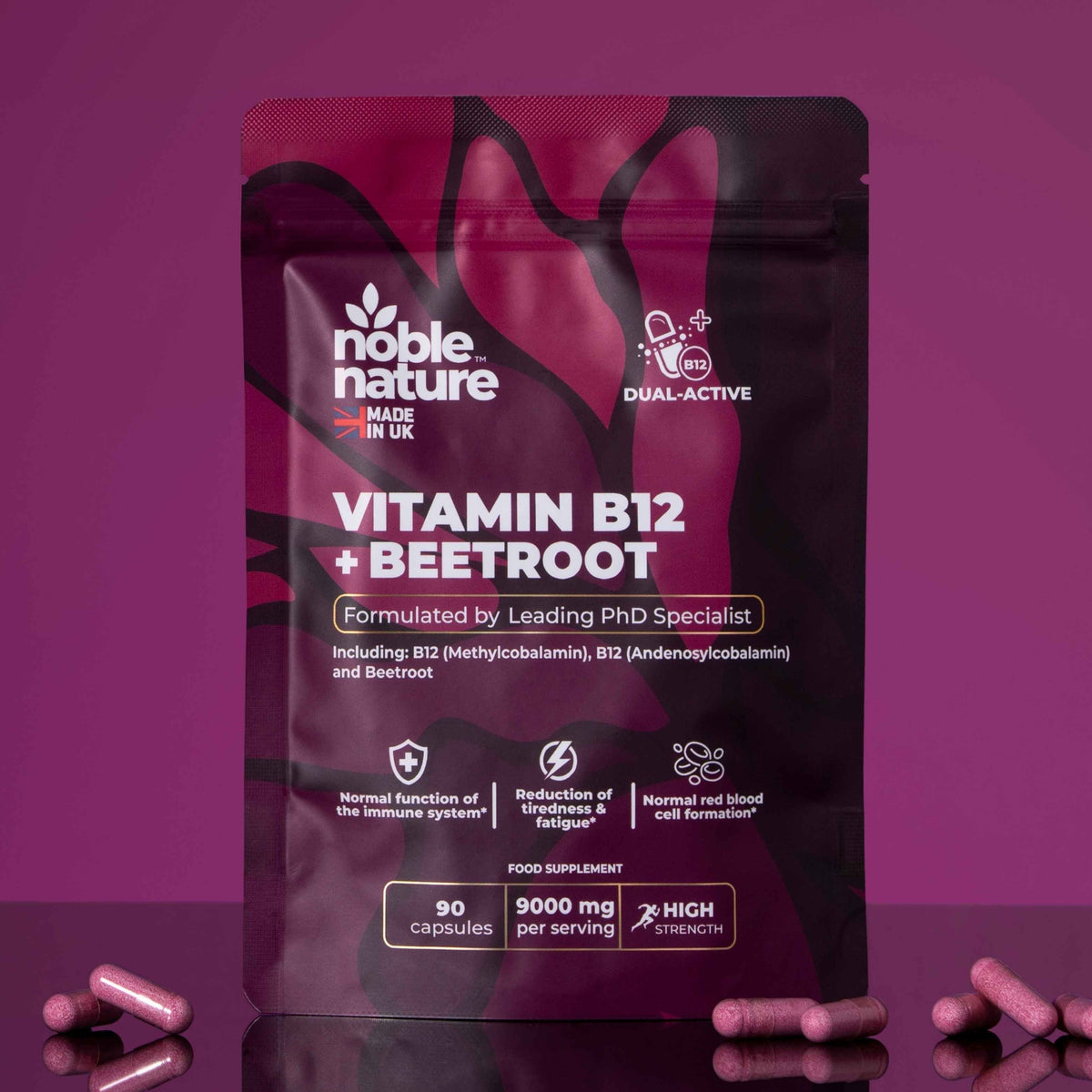
NobleNature's Beetroot + B12 capsules deliver 9,000mg of beetroot equivalent per serving, alongside dual-form B12 (methylcobalamin and adenosylcobalamin), which helps reduce tiredness and fatigue and supports red blood cell formation. Both mechanisms are relevant to running performance. Made in the UK, no fillers.
Three Things That Can Undermine the Effect
Even with good timing and dosage, a few common mistakes reduce how well beetroot works:
-
Using antibacterial mouthwash before or after taking it. The nitrate-to-nitrite conversion relies on oral bacteria. Mouthwash kills those bacteria and can significantly reduce the effect. Avoid it on race morning.
-
Take it with a high-nitrate meal. Eating a large portion of leafy greens, processed meats, or other nitrate-rich foods at the same time does not add to the benefit in a simple linear way, and can cause GI discomfort during a hard effort.
-
Expecting results the first time. Some runners are "non-responders" to dietary nitrate, particularly those who are highly trained. The evidence suggests the effect is more pronounced in recreational runners than elite athletes, which is good news for most Parkrun participants. But give it two or three attempts before drawing conclusions.
The Bottom Line
Beetroot is one of the few legal, evidence-backed ergogenic aids that work for 5K efforts. The science is clear on timing: 2 to 3 hours before your run, at a dose of at least 500mg nitrate equivalent. Take it too late and you are not in the window. Take too little, and the effect disappears.
Parkrun starts at 9am. Set your alarm, take your supplement by 7 am, and run your race knowing the physiology is working in your favour.
One more thing: beetroot turns urine and stools pink or red. This is harmless and temporary. It is called beeturia, and it is worth knowing about before your first dose so it does not cause unnecessary alarm.
Share:
Why NobleNature Partners With PhD Experts to Formulate Every Supplement
How Do Ashwagandha Supplements Work? What the Evidence Actually Shows